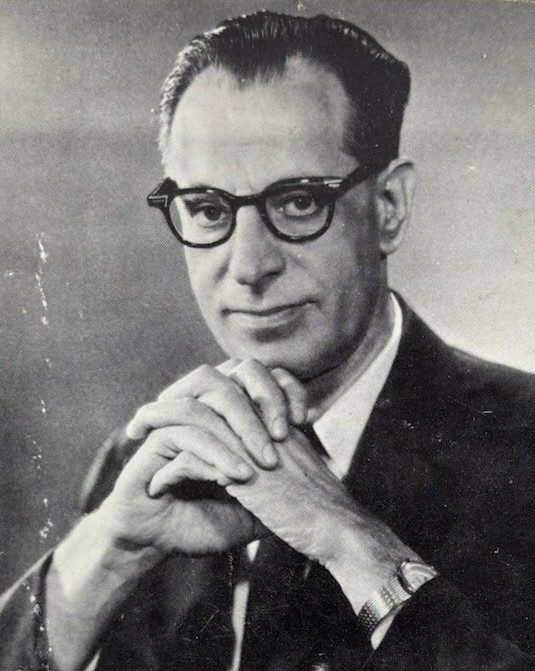
Albert Ellis
1913–2007 · American psychologist, creator of rational emotive behavior therapy
Illness: Type 1 diabetes mellitus
More about: Kidney failure, Type-1 diabetes
Also on: their work on Filopedia
Albert Ellis (Pittsburgh, 1913 – New York, 2007) was an American psychotherapist who developed rational emotive behavior therapy (REBT), which he began to set out in the mid-1950s. His approach holds that much emotional distress comes from the way people interpret events, which places him among the pioneers of cognitive and cognitive-behavioral therapy. In a 1982 survey of psychologists in the United States and Canada, he was ranked the second most influential psychotherapist in history, behind Carl Rogers.
His health was fragile from childhood. At around five years old he was hospitalized with a kidney disease, and later with tonsillitis that developed into a severe streptococcal infection requiring emergency surgery. By his own account, he had eight hospital admissions between the ages of five and seven, one of which lasted almost a year. In his forties he developed diabetes, a condition in which the body cannot properly regulate blood sugar because it produces too little insulin, the hormone that allows cells to use glucose. Some later summaries classify his condition as type 1 diabetes, but the accounts from his lifetime do not specify the type, so this should be read as a later classification rather than a documented diagnosis. Treatment in the mid-twentieth century relied on insulin and careful control of diet, with monitoring far more limited than today.
Other problems followed. A serious intestinal illness in 2004 led to the removal of his large intestine, and a profound hearing loss made his work more difficult. Even so, he kept working at an intense pace, writing by hand and seeing clients. In April 2006 he was hospitalized with pneumonia and spent more than a year moving between hospital and a rehabilitation centre. He died at his residence on the top floor of the institute he had founded, in his wife's arms.
Ellis drew on his own difficulties, including shyness, anger and chronic illness, to explain how the ideas behind REBT had come to him. His autobiography, published after his death, offers that personal perspective on his work.
Key dates
- 1913: born in Pittsburgh into a Jewish family that soon moved to New York.
- 1918: between the ages of five and seven he has several hospital admissions, one lasting nearly a year.
- 1955: begins to set out rational emotive behavior therapy.
- 1982: a survey of psychologists ranks him the second most influential psychotherapist.
- 2004: a serious intestinal illness leads to the removal of his large intestine.
- 2007: dies in New York at the age of 93.
Curiosities and anecdotes
A ranking of influence
In the 1982 survey, Carl Rogers came first, Ellis second and Sigmund Freud third.
A gift from the Dalai Lama
The Dalai Lama sent him a blessed silk scarf for an occasion held in his honour.
Sources
Original Medicapedia text based on:

Last updated: 5 November 2026 · How Medicapedia is made
A project by Alejandro Rosàs Navarro, family physician and specialist in preventive medicine and public health. Spotted a mistake? Write to info@medicapedia.org.