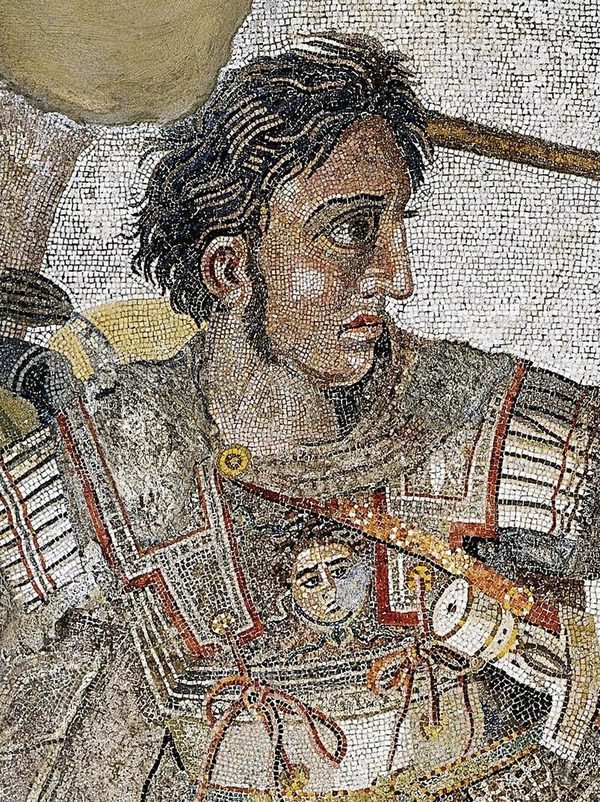
Alexander the Great
355 BC–322 BC · king of Macedon and conqueror of the Achaemenid Persian Empire
Illness: Heterochromia and feverish illnesses
More about: Typhoid fever, Heterochromia
Alexander III of Macedon, known as Alexander the Great, became king of Macedon in 336 BC. Over the following decade he led a military campaign that carried his army from Greece to Egypt and into northwestern India, creating one of the largest empires of antiquity. He was never defeated in battle, and historians regard him as one of the greatest military commanders in history.
Among the conditions recorded for him is heterochromia, a difference in colour between the two eyes or within a single iris. Ancient sources do not describe his eyes in detail, so this detail should be treated with caution. Today it is known that heterochromia can be present from birth or develop later in life, and in most cases it causes no health problems. For that reason it is not considered a serious disorder.
His best documented health problem is a different one. In 333 BC, after plunging into the icy waters of the river Cydnus on a very hot day, he fell gravely ill at Tarsus. For a time his condition was considered desperate, until he recovered thanks to the care of his trusted physician, Philip of Acarnania. Medicine of the period had no antibiotics and no precise understanding of infection, so recovery depended mainly on rest, nursing and the patient's own strength. Modern historians have suggested a respiratory infection or a severe fever, but no diagnosis can be confirmed. The delay caused by the illness gave the army time to regroup before the campaign resumed.
His death in Babylon in June 323 BC has also generated many hypotheses. Accounts describe high fever and progressive weakness, and specialists have proposed causes ranging from malaria or typhoid fever to poisoning. The last idea cannot be tested, and no explanation is conclusive. His death at the age of thirty-two interrupted his plans for expansion and for a new imperial capital. His generals then divided his realm through a series of civil wars, which marked the beginning of the Hellenistic period.
Key dates
- 336 BC Becomes king of Macedon after the assassination of his father, Philip II.
- 333 BC Falls seriously ill at Tarsus after bathing in the icy waters of the Cydnus.
- 324 BC His close friend Hephaestion dies, and the loss deeply affects him.
- 323 BC Dies in Babylon in June, while preparing to return to Greece.
Curiosities and anecdotes
A birth with omens
According to tradition, he was born on the same night that Herostratus set fire to the Temple of Artemis at Ephesus. Persian magi are said to have read the event as a warning of disaster for their empire.
A city named after a horse
After his horse Bucephalus died, Alexander founded a city on the banks of the Hydaspes and named it after the animal.
The horns of Ammon
Alexander presented himself as a son of Zeus-Ammon, and coins of his time showed him with horns as a symbol of his divinity.
Sources
Original Medicapedia text based on:

Last updated: 5 November 2026 · How Medicapedia is made
A project by Alejandro Rosàs Navarro, family physician and specialist in preventive medicine and public health. Spotted a mistake? Write to info@medicapedia.org.