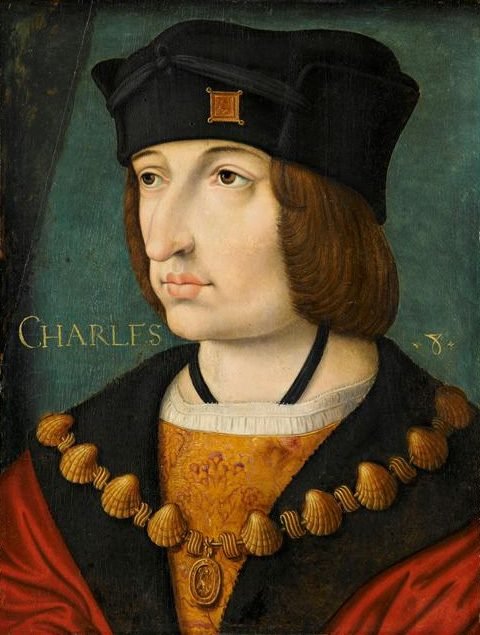
Charles VIII of France
1470–1498 · King of France (1483–1498)
Illness: Frail health; fatal brain injury
More about: Stroke, Polydactyly
Charles VIII ruled France from 1483 to 1498. He came to the throne at thirteen, after the death of his father Louis XI, and his reign is remembered for his marriage to Anne of Brittany, the incorporation of Brittany into the crown, and the Italian expedition that opened the Italian Wars.
Charles was frail from childhood. His father, more worried about his health than his education, forbade him to study Latin and surrounded him with physicians. One of them, Jean Martin, was regarded as the best doctor of the age, and his care is thought to have helped the young prince stay in reasonable health. As an adult, however, Charles's health is described as poor, although no precise diagnosis from his time survives. Contemporary records also mention polydactyly, the presence of extra fingers or toes, a physical trait with no direct link to his death.
Medicine in the late fifteenth century could not explain neurological disorders with any precision. Sudden losses of consciousness were often attributed to supernatural causes, and treatments relied on bloodletting, purgatives and traditional remedies of limited value. For Charles, there is no detailed account of his symptoms before 1498 that would allow a secure diagnosis.
Charles died at the Château d'Amboise, his birthplace, on 7 April 1498. According to the traditional account, he struck his head on the lintel of a door as he left a game of jeu de paume, an early form of real tennis, which he had gone to watch with his wife. He fell into a coma and died nine hours later. This version has been questioned. A 2021 study argues that a blow of that kind would have caused only minor trauma, and proposes instead severe brain injuries, possibly linked to epilepsy, which in turn may have resulted from neurosyphilis. This hypothesis is debated, and modern medicine cannot confirm it because no direct evidence survives.
Neurosyphilis is an infection of the nervous system caused by untreated syphilis, and in the fifteenth century there was no effective cure for it. There is no conclusive evidence that Charles had the disease, so it should be treated as a possibility rather than an established fact.
His death had lasting consequences. With no surviving male heir, the crown passed to his cousin Louis of Orléans, who reigned as Louis XII, annulled his marriage to Joan of Valois and married Charles's widow, Anne of Brittany. The Italian campaign of 1494, meanwhile, opened a long conflict that shaped European politics for decades.
Key dates
- 1483 Ascends the throne at thirteen after the death of his father, Louis XI.
- 1491 Marries Anne of Brittany, which paved the way for the duchy's union with the crown.
- 1494 Begins the expedition to Italy, in which the French army advanced with little resistance.
- 1495 His first son, Charles Orlando, dies of measles at the age of three.
- 1498 Dies on 7 April at Amboise after an accident that tradition places during a game of jeu de paume.
Curiosities and anecdotes
A climb in the Alps
During a pilgrimage to pay respects to his father's remains, Charles saw the Mont Aiguille and ordered his men to climb to its summit, in one of the earliest technical alpine climbs on record. Rabelais later alluded to the feat.
His death on screen
The television series Borgia recreates his death with a twist: the king plays jeu de paume with Cesare Borgia, loses, and strikes his head as he leaves the game. The Spanish series Isabel (2012) also depicts his death.
Sources
Original Medicapedia text based on:

Last updated: 5 November 2026 · How Medicapedia is made
A project by Alejandro Rosàs Navarro, family physician and specialist in preventive medicine and public health. Spotted a mistake? Write to info@medicapedia.org.