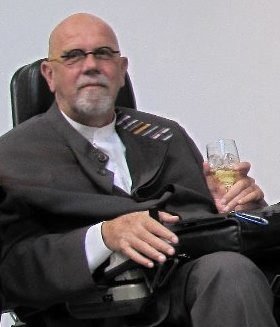
Chuck Close
1940–2021 · American painter and photographer
Illness: Quadriplegia and prosopagnosia
More about: Prosopagnosia, Tetraplegia
Also on: their painting on Pinacopedia
Charles Thomas "Chuck" Close (1940-2021) was an American painter and photographer known for large-scale portraits based on photographs. As a child he had a neuromuscular condition that made it hard to lift his feet, and nephritis, an inflammation of the kidneys, kept him out of school for much of sixth grade. At school he struggled with reading because of dyslexia, which was not diagnosed at the time.
Close also said he had prosopagnosia, or face blindness, a condition that makes it difficult to recognize new faces. He suggested it may have been part of what first drew him to portraiture, although this is his own interpretation rather than an established fact. His method involved overlaying a grid on both the photograph and the canvas and copying one cell at a time, using unusual tools such as an airbrush, rags, razor blades and an eraser mounted on a power drill.
The turning point came in 1988. After giving a speech, he suffered an occlusion of the anterior spinal artery, a blockage of the blood supply to the spinal cord that left him paralyzed from the neck down. Medicine at the time could offer rehabilitation and support, but could not restore the lost movement. Close returned to work by adapting his methods: brushes were strapped to his wrist, and assistants took part in much of the process, which changed his pace and the level of detail he could achieve.
Today specialists regard this kind of spinal artery blockage as uncommon, and the extent of paralysis depends on which part of the spinal cord is affected. Retrospective accounts of the episode rely on the medical reports that were published, and some details remain uncertain.
In 2015 he was diagnosed with frontotemporal dementia, a disease affecting the frontal and temporal lobes of the brain that can alter behavior and impulse control. After his death, his neurologist, Thomas M. Wisniewski, said that inappropriate sexual conduct alleged to have taken place between 2001 and 2013 could be linked to this condition. The explanation was presented as a medical interpretation, and the question of responsibility for those actions was left open.
Close died in Oceanside, New York, in August 2021, at the age of 81, from congestive heart failure. Despite his illnesses, he remained active and was widely honored, receiving the National Medal of Arts from President Bill Clinton in 2000 and more than twenty honorary degrees. His later years show how illness can change the way an artist works without ending his career.
Key dates
- 1988 An occlusion of the anterior spinal artery leaves him paralyzed from the neck down.
- 2015 He is diagnosed with frontotemporal dementia.
- 2021 He dies in Oceanside, New York, at the age of 81, from congestive heart failure.
Curiosities and anecdotes
Brushes strapped to his wrist
After losing movement, Close strapped brushes to his wrist to keep painting. His method was adapted to this new situation.
An eraser on a drill
In his early works he used an eraser mounted on a power drill, among other unconventional tools.
Sources
Original Medicapedia text based on:

Last updated: 5 November 2026 · How Medicapedia is made
A project by Alejandro Rosàs Navarro, family physician and specialist in preventive medicine and public health. Spotted a mistake? Write to info@medicapedia.org.