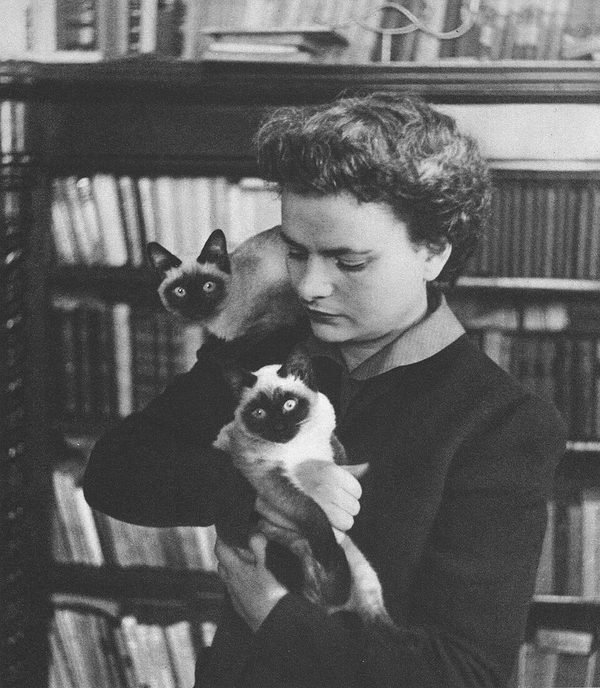
Elsa Morante
1912–1985 · Italian novelist, poet and children's author
Illness: Depression and hydrocephalus
More about: Myocardial infarction, Depression
Also on: their work on Filopedia
Elsa Morante (Rome, 1912 – Rome, 1985) was one of the most important Italian novelists of the second half of the twentieth century, and also a poet, translator and writer for children.
She was born in the working-class Testaccio district of Rome, the daughter of Irma Poggibonsi, a schoolteacher from a Jewish family, and Francesco Lo Monaco, a postal clerk who later took his own life. She was formally acknowledged by Augusto Morante, a warden at a correctional institution for young people. For health reasons she did not attend primary school and was educated privately, spending much of her childhood with her godmother in a villa on Via Nomentana. She began writing stories, fables and poems at an early age, and from 1933 they appeared in magazines. Her first book, Il gioco segreto, was published in 1941, the same year she married the novelist Alberto Moravia.
During the German occupation of Italy late in the Second World War, Morante and Moravia, fearful because of their Jewish heritage, fled Rome and took refuge in a village in southern Lazio. After the war, the American translator William Weaver helped them reach English-speaking readers.
In her later years she suffered intense pain in one leg and declined a further operation. In April 1983 she attempted suicide and was rushed to hospital, where she was diagnosed with severe hydrocephalus, a condition in which an abnormal build-up of fluid inside the skull can press on the brain. An operation did not improve her condition, and a second surgical procedure preceded her death from a heart attack at a clinic in Rome on 25 November 1985.
Medical records also mention depression. Today specialists and historians can only offer retrospective hypotheses: her low mood, her physical pain and the hydrocephalus may have influenced one another, but this cannot be verified. They are best understood as informed speculation rather than firm diagnoses.
Illness shaped the final part of her life but not her work, which includes L'isola di Arturo (1957), La Storia (1974) and Aracoeli, published in 1982 and awarded the Médicis prize for foreign fiction. La Storia, set around a Roman family during the war, is now regarded as one of her most important books.
Key dates
- 1912 Born in Rome, in the Testaccio district.
- 1941 Publishes Il gioco segreto, her first book.
- 1959 Meets the painter Bill Morrow in New York, beginning an intense relationship.
- 1962 Morrow dies after falling from a skyscraper window; it is not known whether it was an accident or deliberate.
- 1983 Attempts suicide and is diagnosed with severe hydrocephalus.
- 1985 Dies in Rome of a heart attack after a second operation.
Curiosities and anecdotes
A translator who opened doors
After the war, William Weaver helped Morante and Moravia reach readers in the English-speaking world.
A novel on a famous list
La Storia appears on the Bokklubben World Library list of the 100 best books of all time.
Sources
Original Medicapedia text based on:

Last updated: 5 November 2026 · How Medicapedia is made
A project by Alejandro Rosàs Navarro, family physician and specialist in preventive medicine and public health. Spotted a mistake? Write to info@medicapedia.org.