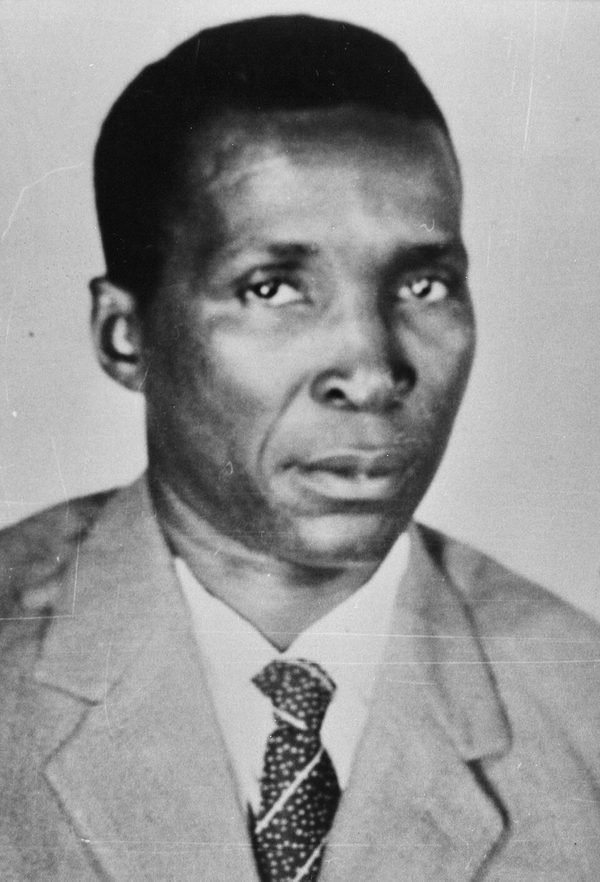
Francisco Macías Nguema Biyoko
1924–1979 · Equatoguinean dictator
Illness: Childhood tuberculosis and psychiatric disorders
More about: Gunshot wound, Schizophrenia, Antisocial personality disorder, Paranoid personality disorder
Francisco Macías Nguema was the first president of Equatorial Guinea after independence in 1968, and his rule became one of the most brutal dictatorships of the twentieth century. Born in 1924 into a poor Fang farming family, he survived several bouts of tuberculosis, a bacterial infection of the lungs that could be fatal at the time. Sources report that he came close to death more than once as a child and young man, and that he recovered with medical care, an experience that may have left him with a lasting fear of dying.
As a political figure, his behaviour drew attention from those around him. Before the 1968 elections he travelled to Madrid for medical care, and a Spanish doctor privately described him as paranoid and schizoid. During another stay in Spain he was also diagnosed with manic-depressive illness, now called bipolar disorder. Psychiatric treatment at the time relied mainly on drugs and talking therapies. Little is known about the advice the specialist gave him, and historians generally agree that it had little effect, since his behaviour grew more erratic once he held power.
Today, psychiatrists and historians treat these diagnoses as retrospective hypotheses rather than firm conclusions. Schizophrenia, paranoid personality disorder, antisocial personality disorder and psychopathy, a pattern marked by a lack of empathy and remorse, have all been suggested. Some observers link these traits to childhood trauma and to drug use, including cannabis and iboga, a plant preparation with hallucinogenic effects. Others warn that diagnosing a person who died decades ago is speculative, and the question remains debated.
The illness shaped his government. After taking office he gathered all the powers of the state, merged the parties into a single party, declared himself president for life in 1972, and passed laws that made insulting him punishable by death. Suspicion of everyone around him led to executions, persecution and the flight of many educated people, leaving the country with almost no doctors. In 1973 he refused aid during a cholera outbreak on the island of Pagalu, where around a hundred people died.
His end came in 1979, when a coup led by his nephew Teodoro Obiang overthrew him. He was tried in a public trial, sentenced to death and executed. His case is now studied as an example of how untreated mental illness, combined with absolute power, can cause enormous harm to a whole society.
Key dates
- 1924 Born into a Fang farming family, in the area of today's Mongomo.
- 1967 A Spanish doctor privately describes him as paranoid and schizoid.
- 1973 He bans aid during the cholera epidemic on the island of Pagalu.
- 1979 He is overthrown in a coup led by his nephew and executed shortly afterwards.
Curiosities and anecdotes
Banned glasses
He is said to have ordered that those who wore glasses be punished by death, and to have banned the word 'intellectual'.
A country without doctors
Towards the end of his rule only two doctors and fewer than a dozen technical school graduates remained in the country.
Burned money
It is believed that before his capture he burned part of the country's reserves, around 100 million dollars, as an act of revenge.
Sources
Original Medicapedia text based on:

Last updated: 5 November 2026 · How Medicapedia is made
A project by Alejandro Rosàs Navarro, family physician and specialist in preventive medicine and public health. Spotted a mistake? Write to info@medicapedia.org.