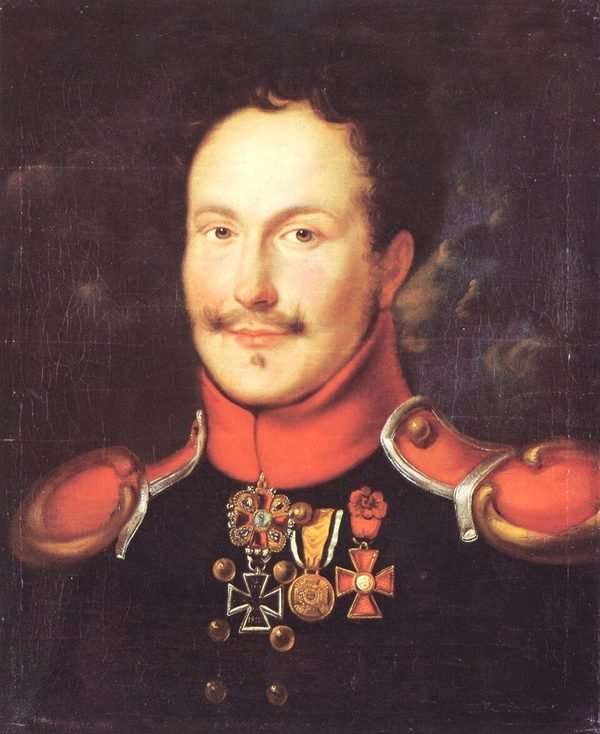
Friedrich de la Motte Fouqué
1777–1843 · German Romantic writer
Illness: Stroke (cerebrovascular accident)
More about: Stroke
Also on: their work on Filopedia
Friedrich Heinrich Karl de la Motte Fouqué, a baron of Huguenot descent, was one of the most representative figures of German Romanticism. He was born in Brandenburg an der Havel in 1777 and died in Berlin in 1843. The grandson of one of Frederick the Great's generals and the son of a Prussian army officer, he left his university studies to join the army and took part in the Rhine campaign of 1794. He later devoted himself entirely to literature.
Little detail survives about his health. The affliction recorded for him is a cerebrovascular accident, or stroke, meaning a sudden interruption of blood flow to part of the brain. This deprives brain cells of oxygen and can leave lasting effects depending on its extent and location. The surviving accounts do not say when the episode occurred, what symptoms he had or what treatment he received, so his clinical course cannot be reconstructed reliably. In his time, doctors diagnosed such episodes mainly from visible signs, such as paralysis, difficulty speaking or loss of consciousness, since brain imaging did not yet exist. Treatments were limited and aimed largely at easing symptoms.
Today medicine treats a stroke as an emergency requiring immediate care, but applying that knowledge to a historical case remains a hypothesis. Any attempt to identify its exact cause, such as the blood vessels involved or the role of blood pressure, would be speculation without documentary support.
His literary reputation rests mainly on Undine, which appeared around 1811 and is the work by which he is still remembered. His drama Sigurd der Schlangentöter (1808) was an early attempt to stage the Nibelungenlied, and that material later inspired Richard Wagner's tetralogy Der Ring des Nibelungen. In his final years, King Frederick William IV of Prussia granted him a pension that allowed him to live in comfort.
Key dates
- 1777 Born in Brandenburg an der Havel on 12 February.
- 1804 His first book, Dramatische Spiele von Pellegrin, is published with the encouragement of August Wilhelm Schlegel.
- 1843 Dies in Berlin; the affliction recorded for him is a cerebrovascular accident.
Curiosities and anecdotes
An influence on Wagner
His 1808 drama Sigurd der Schlangentöter was one of the first attempts to bring the Nibelungenlied to the stage. The same material later inspired Richard Wagner's operatic tetralogy.
An unexpected admirer
The British writer and designer William Morris admired Sintram and His Companions, and the book influenced his own fiction.
Sources
Original Medicapedia text based on:

Last updated: 5 November 2026 · How Medicapedia is made
A project by Alejandro Rosàs Navarro, family physician and specialist in preventive medicine and public health. Spotted a mistake? Write to info@medicapedia.org.