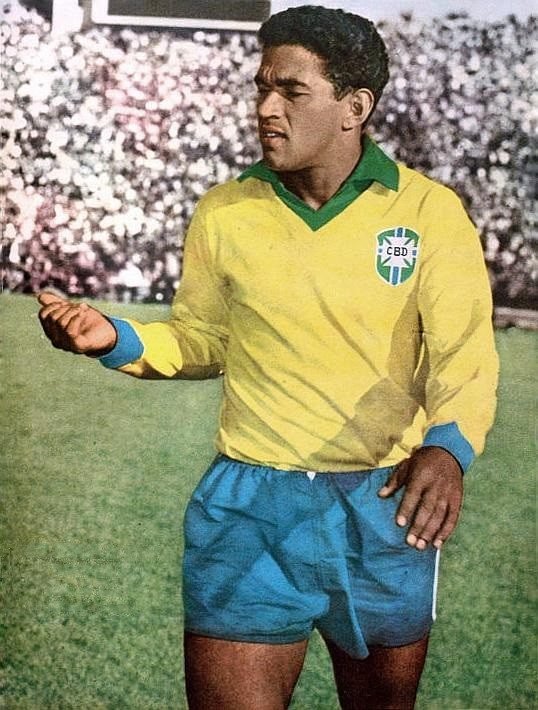
Garrincha
1933–1983 · Brazilian footballer, right winger
Illness: Polio and chronic alcoholism
More about: Liver cirrhosis, Poliomyelitis
Manuel Francisco dos Santos, known as Garrincha, was a Brazilian footballer who played as a right winger and who many regard as one of the greatest dribblers in the history of the game. He was born in 1933 in Pau Grande, in the municipality of Magé, in the state of Rio de Janeiro, and died in Rio in 1983, at the age of 49.
From childhood he had serious deformities in his legs: his right leg was about six centimetres shorter than his left, his feet turned markedly inwards or outwards, and his spine was curved. Polio, a viral infection that damages the motor nerves of the spinal cord and can leave paralysis and deformities, added to these problems. Surgeries in his childhood did not achieve the results hoped for. His sister gave him the nickname Garrincha, the name of a small Brazilian bird that is fast but a clumsy flier, an image of a free and quick creature that stayed with him.
Doctors did not predict a sporting future for him, but Garrincha learned to play and turned his irregular legs into his greatest asset. His uneven running gait confused defenders: he would feint towards one side and then dash off the other. His first professional club was Botafogo of Rio de Janeiro, where he played from 1953 and enjoyed his most brilliant years. With the Brazilian national team he won the World Cups of Sweden in 1958 and Chile in 1962; in the latter he was the standout player of the tournament while Pelé was injured. After Botafogo he played for Corinthians, Junior of Barranquilla and Flamengo, and ended his career at Olaria in 1973.
Off the pitch, Garrincha had a very difficult relationship with alcohol, which he had inherited from his father, and with tobacco. His dependence worsened over the years, with episodes of out-of-control behaviour and family problems. Historians agree that chronic alcoholism was the main cause of his physical decline. According to the medical reports of the time, he died from pulmonary congestion, pancreatitis and pericarditis, all within the picture of chronic alcoholism. Pancreatitis is inflammation of the pancreas, and pericarditis is inflammation of the membrane surrounding the heart.
His legacy remains very alive in Brazil. Teammates described him as having a childlike spirit, and the public called him the Joy of the People for the delight he gave with his dribbling. Today, medicine holds that his polio and skeletal deformities shaped his physical life, but that his alcohol dependence was decisive in his death. This retrospective reading is the most widely accepted one, although some aspects of his clinical history cannot be fully verified from documents of the time.
Key dates
- 1933 Born in Pau Grande, in the state of Rio de Janeiro, with deformed legs.
- 1953 Debuts with Botafogo, where he would spend most of his career.
- 1958 Wins his first World Cup with Brazil in Sweden.
- 1962 Shines at the World Cup in Chile and is named player of the tournament.
- 1983 Dies in Rio de Janeiro, in the context of chronic alcoholism.
Curiosities and anecdotes
A bird's name
His sister gave him the nickname Garrincha, after a small Brazilian forest bird, which later inspired the image of his play.
A bewildered defender
In a club match with Botafogo he made the River Plate defender Vairo chase him around the pitch, while the crowd's cheers of olé turned into laughter.
Sources
Original Medicapedia text based on:

Last updated: 5 November 2026 · How Medicapedia is made
A project by Alejandro Rosàs Navarro, family physician and specialist in preventive medicine and public health. Spotted a mistake? Write to info@medicapedia.org.