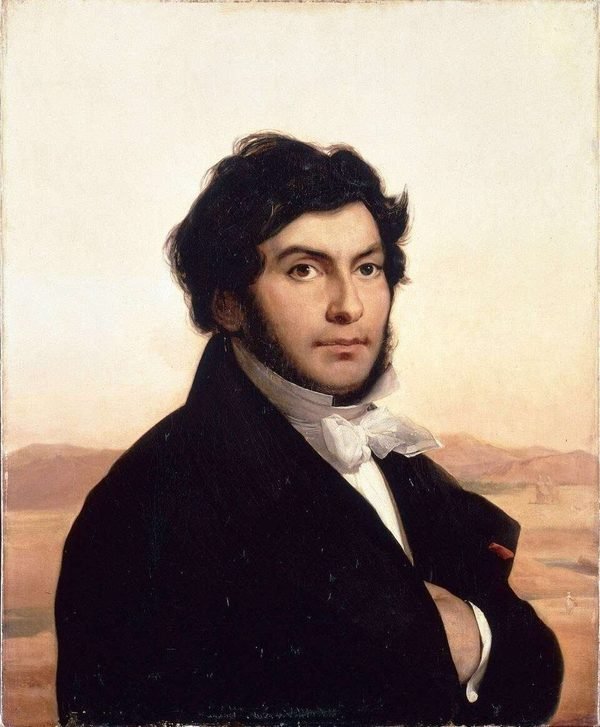
Jean-François Champollion
1790–1832 · French linguist and Egyptologist, father of Egyptology
Illness: Gout and possible tuberculosis
More about: Stroke, Cardiac arrest, Tuberculosis
Jean-François Champollion (Figeac, 1790 – Paris, 1832) was a French linguist and Egyptologist who deciphered Egyptian hieroglyphs by studying the Rosetta Stone. For this achievement he is regarded as the father of Egyptology. From an early age he showed an exceptional gift for languages. He learned Coptic, Arabic, Hebrew and other oriental tongues, and while still young he was already well known in French scientific circles.
His health was fragile from youth. Historical sources record chronic poor health, including gout, a condition that causes painful joint inflammation when uric acid crystals build up in the body, as well as ringing in the ears, known as tinnitus. His condition worsened during his years in Paris, where the damp climate and poor sanitation did not agree with him, and it declined further after the arduous journey to Egypt in 1828–1829. On his return he was offered a professorship in Egyptology, but he gave only a few lectures before ill health forced him to give up teaching.
In his time, gout was managed with diet, rest and remedies such as bloodletting and purgatives, treatments that medicine now considers largely ineffective. Some records also point to tuberculosis, a bacterial infection that caused many deaths in the nineteenth century, mainly by attacking the lungs. Historians still debate whether it was the cause of his decline. Without direct medical evidence, any retrospective diagnosis remains a hypothesis, and it is not certain that these illnesses fully explain his deterioration. He died in Paris in 1832, aged 41.
His illness marked his final years but did not halt his work. His grammar of Ancient Egyptian was published after his death, thanks to the care of his brother Jacques-Joseph. For decades, some scholars disputed his methods and accused him of failing to acknowledge the early advances of the Englishman Thomas Young adequately. Over time, later discoveries and the confirmation of his readings by other scholars established the acceptance of his work, which remains the foundation of Egyptology.
Key dates
- 1806 At sixteen, his letters already show a strong interest in the study of ancient Egypt.
- 1822 He publishes his first advance in deciphering hieroglyphs, showing that the Egyptian script combined phonetic and ideographic signs.
- 1824 He publishes the Précis, detailing his decipherment of the hieroglyphic script.
- 1829 He travels to Egypt, a physically demanding journey that seriously worsens his health.
- 1832 He dies in Paris, aged 41.
Curiosities and anecdotes
An Arabic name
During his student years in Paris he wore Arab clothing and called himself Al Seghir, the Arabic translation of « le jeune », meaning the young one.
An early encounter with hieroglyphs
According to one biographer, Joseph Fourier, prefect of Grenoble and a member of Napoleon's expedition, showed the boy his collection of Egyptian antiquities. Champollion then declared that he would be the one to decipher them, although this account is not confirmed by other sources.
Sources
Original Medicapedia text based on:

Last updated: 5 November 2026 · How Medicapedia is made
A project by Alejandro Rosàs Navarro, family physician and specialist in preventive medicine and public health. Spotted a mistake? Write to info@medicapedia.org.