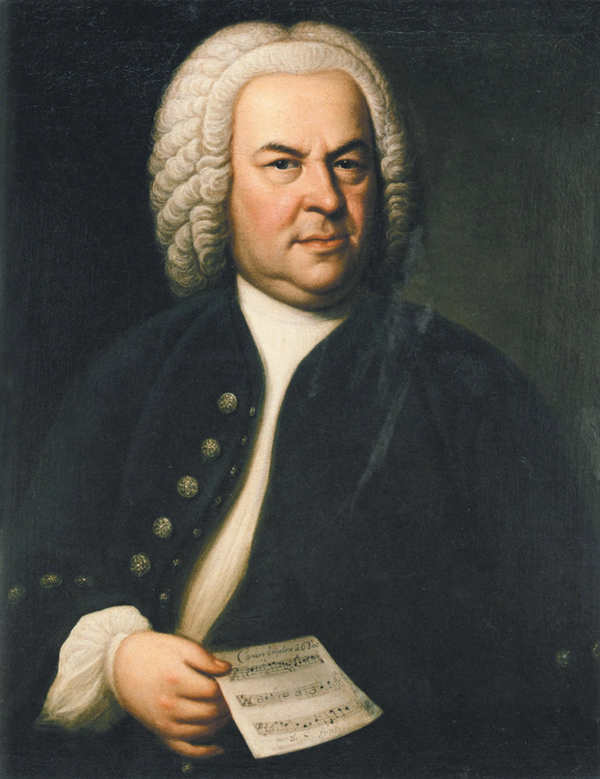
Johann Sebastian Bach
1685–1750 · German Baroque composer and organist
Illness: Cataracts and blindness
Also on: their music on Classicapedia
Johann Sebastian Bach (1685-1750) was a German composer, organist and teacher of the Baroque period, and the most important member of the Bach family of musicians. His vast and varied output is today a central reference in Western music. Yet the last years of his life were marked by failing eyesight that ended in blindness.
The sources do not allow us to establish exactly when his eye problems began. Accounts of the period suggest that his sight declined gradually, to the point that reading scores and copying music, which he had done throughout his career, became difficult. Today the most commonly proposed explanation is a cataract, a clouding of the lens, the natural transparent structure inside the eye. Some specialists have argued that it may instead have been glaucoma, a condition in which raised pressure inside the eye damages the optic nerve. These remain hypotheses, since no detailed clinical descriptions survive.
In the eighteenth century, cataract surgery meant pushing the clouded lens back into the eye, without effective anaesthesia or reliable hygiene, so the risk of infection was very high. Bach was operated on in 1749. According to the most widely repeated account, the operation was unsuccessful, and soon afterwards he underwent a second procedure performed by an itinerant oculist. He seemed to regain some vision at first, but his sight worsened again and he became blind. He died in Leipzig on 28 July 1750, aged 65, after complications that followed the surgery. Today it is considered likely that infection or severe inflammation contributed to his death, although this cannot be confirmed.
Blindness did not stop his work at once. In his final years he revised and extended many earlier compositions, and some, such as The Art of Fugue, were left unfinished. He probably relied more and more on copyists and family members to write out his manuscripts, which changed the way he worked in his last months. His music, however, continued to grow in reputation after his death, and his illness plays only a small part in the image later generations formed of him.
Key dates
- 1749 He undergoes a first cataract operation, which the sources describe as unsatisfactory.
- 1750 A second procedure, carried out by an itinerant oculist, leaves the composer completely blind.
- 1750 He dies in Leipzig on 28 July, aged 65, after complications following the surgery.
Curiosities and anecdotes
Twenty children
He had twenty children across his two marriages, and four of them became composers.
A tribute from Reincken
According to a reported account, after hearing him improvise in 1720, the organist Johann Adam Reincken said he had thought that art was dead, but saw that it lived in Bach.
Sources
Original Medicapedia text based on:

Last updated: 5 November 2026 · How Medicapedia is made
A project by Alejandro Rosàs Navarro, family physician and specialist in preventive medicine and public health. Spotted a mistake? Write to info@medicapedia.org.