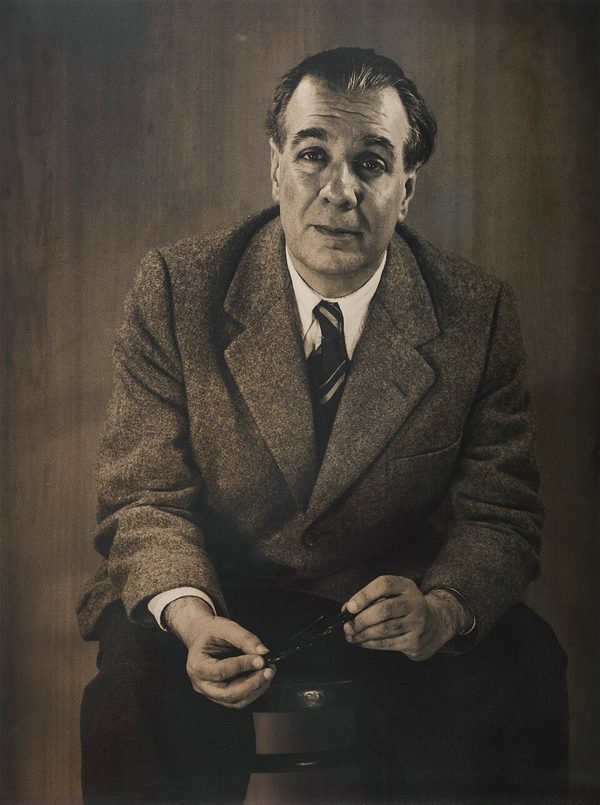
Jorge Luis Borges
1899–1986 · Argentine writer, poet and translator
Illness: Progressive blindness
More about: Pulmonary emphysema, Liver cancer, Blindness
Also on: their work on Filopedia
Jorge Luis Borges was an Argentine short-story writer, poet, essayist and translator, author of the stories collected in Ficciones and El Aleph, and one of the central figures of twentieth-century literature in Spanish.
Blindness shaped much of his life. His father, Jorge Guillermo Borges, lost his sight gradually because of a hereditary condition that forced him to retire from teaching in 1914. The same process began to affect Borges himself in his thirties, and by the age of 55 he was almost completely blind.
In that period, ophthalmology had limited means to treat diseases that damage the retina or the optic nerve, the structures that carry the image to the brain. His father travelled to Europe for a specialised eye treatment, although the sources consulted do not make clear what results he obtained. For Borges, no specific diagnosis from his own time is recorded. Today, the exact cause of his loss of sight is not documented with certainty. Some specialists have suggested a hereditary origin, in line with his father's case, but this remains a hypothesis that the available evidence cannot confirm.
Blindness also left a clear mark on his writing. Some scholars argue that his loss of sight led him to favour poetry and short stories over novels, and to develop elaborate literary symbols such as labyrinths, mirrors and libraries, which were built through imagination rather than direct observation. This is a plausible interpretation rather than a certainty, and his work allows other readings.
His situation also affected his daily work. Before achieving fame he had worked as a librarian, teacher and lecturer, and in 1955 he was appointed director of the National Public Library of Argentina, a post he took up with his sight already greatly reduced. In 1961 he received the first International Formentor Prize, shared with Samuel Beckett, which brought him international recognition. Borges continued writing, translating and lecturing until his death in Geneva in 1986.
Key dates
- 1914 Borges's father retires from teaching because of progressive blindness, and the family travels to Europe in search of eye treatment.
- 1938 After a serious head injury on Christmas Eve, Borges nearly dies from sepsis, a widespread infection.
- 1955 He is appointed director of the National Public Library of Argentina, with his sight already greatly diminished.
- 1961 He receives the first International Formentor Prize, shared with Samuel Beckett, which brings him international fame.
Curiosities and anecdotes
An early translation
According to the sources, as a child he translated Oscar Wilde's The Happy Prince into Spanish, and when it was published in a local newspaper some of his friends believed his father was the real translator.
Regret for early publications
Later in life, Borges regretted some of his early publications and tried to buy every known copy so that they would be destroyed.
Sources
Original Medicapedia text based on:

Last updated: 5 November 2026 · How Medicapedia is made
A project by Alejandro Rosàs Navarro, family physician and specialist in preventive medicine and public health. Spotted a mistake? Write to info@medicapedia.org.