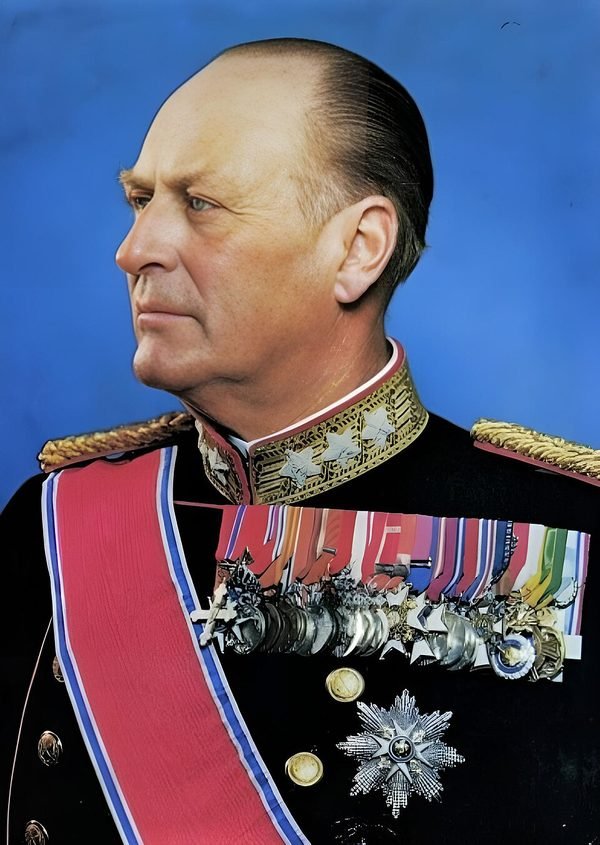
Olav V of Norway
1903–1991 · King of Norway, 1957–1991
Illness: Heart attack (registered dyslexia)
More about: Myocardial infarction, Dyslexia
Olav V of Norway, born Prince Alexander of Denmark at Sandringham House in England on 2 July 1903, reigned as King of Norway from 1957 until his death in 1991. He was the only child of Prince Carl of Denmark, who became King Haakon VII of Norway in 1905, and of Princess Maud, daughter of King Edward VII of the United Kingdom. After his father's election he was raised in Norway, and he became the first heir to the Norwegian throne to be educated in the country since the Middle Ages. His parents made sure his upbringing was as Norwegian as possible. During the Second World War he stood beside his father in defending the country's institutions, and in 1944 he was appointed Chief of Defence, a post that earned him the respect of Allied leaders.
The surviving accounts say little about the early course of his health problems. What is documented is that from 1957, as his father's health declined, Olav took on more and more public duties on his behalf. That year Haakon died and Olav succeeded him. He was a widower, since Princess Märtha had died in 1954, and he carried out his duties without a queen at his side. His plain and approachable manner earned him the nickname 'The People's King' (Folkekongen).
In the summer of 1990 he suffered health problems and improved somewhat around Christmas, although he never fully returned to official duties. On 17 January 1991 he suffered a heart attack, meaning the blood supply to part of the heart muscle was cut off, and died at his residence in Holmenkollen, Oslo. Retrospective diagnoses are not conclusive, because the accounts that survive do not describe the 1990 problems in detail. He is also registered as having dyslexia, a learning difficulty affecting reading and writing, although no detailed records show how it affected him. Treatments for heart disease in his era were far more limited than they are today.
His death brought an immediate public response. Thousands of Norwegians gathered at the Royal Palace in Oslo with candles and letters, and the letters are now kept in the national archives. He was buried beside his wife in the royal mausoleum at Akershus Fortress. In 2005 the Norwegian Broadcasting Corporation voted him 'Norwegian of the Century'.
Key dates
- 1957 As his father's health declined, Olav took on more public duties, and after Haakon's death he succeeded to the throne.
- 1990 In the summer he suffered health problems and improved somewhat around Christmas, without regaining full official activity.
- 1991 On 17 January he suffered a heart attack and died at his residence in Holmenkollen, Oslo.
Curiosities and anecdotes
A miniature car
In 1913 a miniature car commissioned by Queen Alexandra for the young Crown Prince Olav appears in a film of the period towing a procession of Londoners. The film is held by the British Film Institute.
Four million bodyguards
Asked how he dared go out in public without bodyguards, he replied that he had four million, referring to the population of Norway at the time.
An Antarctic coast
An area of Antarctica of about 180,000 square kilometres is named after him: the Prince Olav Coast, together with the Prince Olav Mountains.
Sources
Original Medicapedia text based on:

Last updated: 5 November 2026 · How Medicapedia is made
A project by Alejandro Rosàs Navarro, family physician and specialist in preventive medicine and public health. Spotted a mistake? Write to info@medicapedia.org.