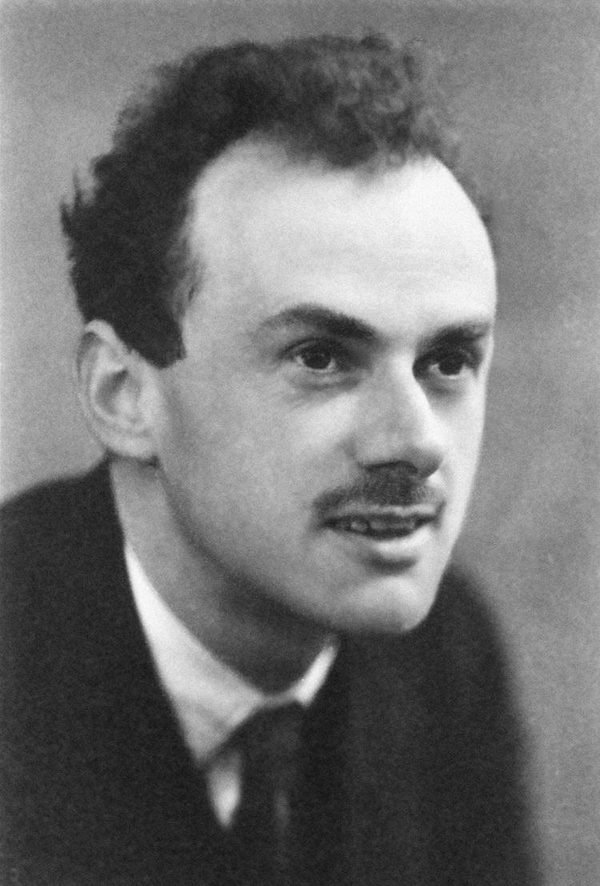
Paul Dirac
1902–1984 · British theoretical physicist and mathematician, a pioneer of quantum mechanics
Illness: Prosopagnosia (face blindness), with a hypothesis of autism-spectrum traits
More about: Prosopagnosia
Also on: their science on Newtonpedia
Paul Dirac was a British theoretical physicist and mathematician whose work was decisive for quantum mechanics and quantum electrodynamics. His name is linked to the equation describing the electron and to the prediction of antimatter.
The sources consulted do not describe specific episodes of prosopagnosia, the condition that makes it hard to recognise familiar faces, although it is listed among the conditions recorded in his file. No details survive about how it was diagnosed or treated at the time. What the texts do document is a very reserved way of relating to others, with little conversation, difficulty in social life and a lack of empathy that colleagues found unusual.
His childhood in Bristol was shaped by a strict and authoritarian father, a French teacher who required his children to speak only French at home. According to Dirac himself, when he could not express what he wanted in French, he preferred to stay silent. The suicide of his older brother Felix in 1925 was a grief he later remembered deeply.
Dirac trained first in electrical engineering and then in mathematics, and ended up at Cambridge, where he earned his doctorate in 1926 with a thesis regarded as the first on quantum mechanics. In 1928 he formulated the equation that bears his name, which joined quantum mechanics with special relativity and anticipated the positron. In 1933 he shared the Nobel Prize in Physics with Erwin Schrödinger. He held the Lucasian Chair of Mathematics at Cambridge from 1932 to 1969 and spent his final years at Florida State University, where he died in 1984.
Graham Farmelo's biography, published in 2009, suggested that Dirac may have had Asperger syndrome, based on his very literal language and limited social life. This is a retrospective hypothesis that cannot be tested, and some historians note that the difficult, taciturn character of Paul himself also shaped family relations. Prosopagnosia remains a recorded fact without detailed firsthand accounts that would allow a precise description.
His reticence became legendary. A unit, the dirac, was named for the smallest number of words that could be spoken in a conversation. His work was guided by the belief that the laws of nature should have the simplicity and beauty of mathematics, a standard he applied long before experimental evidence was available.
Key dates
- 1902 Born in Bristol, into a family of Swiss and French origin.
- 1925 His older brother Felix dies by suicide, an event he later recalled with grief.
- 1929 He travels with Werner Heisenberg to a conference in Japan, an episode biographers cite to illustrate his difficulty with social life.
- 1984 Dies in Tallahassee, Florida.
- 2009 Graham Farmelo's biography suggests he may have had Asperger syndrome.
Curiosities and anecdotes
A remark about God
According to Pauli, Dirac had a religion whose guiding principle was that there is no God and Paul Dirac is his prophet. Everyone present laughed, Dirac included.
The dirac unit
The dirac was coined as a humorous unit for the smallest number of words that could be spoken in a conversation, referring to his reputation for silence.
A letter from Einstein
In a 1926 letter to Paul Ehrenfest, Einstein wrote that he was struggling with a paper by Dirac and found the balance between genius and madness along that path horrible.
Sources
Original Medicapedia text based on:

Last updated: 5 November 2026 · How Medicapedia is made
A project by Alejandro Rosàs Navarro, family physician and specialist in preventive medicine and public health. Spotted a mistake? Write to info@medicapedia.org.