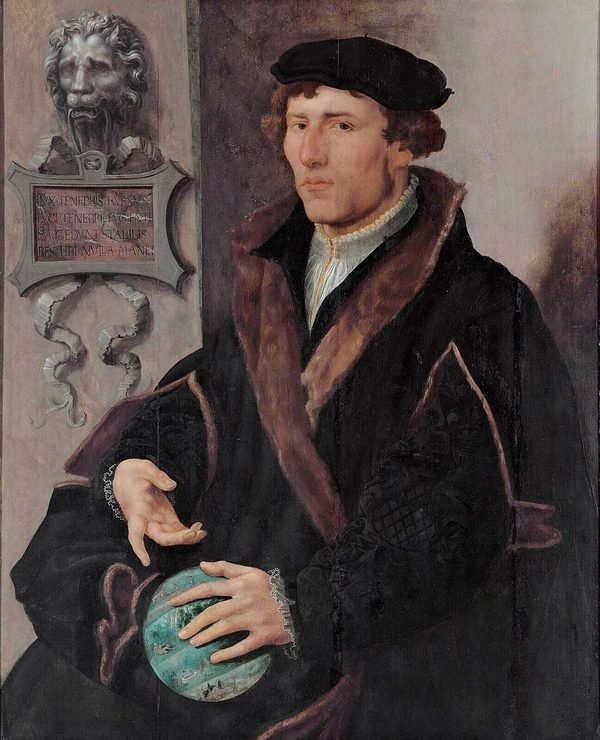
Gemma Frisius
1508–1555 · Dutch physician, mathematician and cartographer
Illness: Clubfoot and kidney stones
More about: Kidney failure, Clubfoot
Regnier Gemma Frisius (Dokkum, 1508 - Leuven, 1555) was a Dutch physician, mathematician and cartographer, known for making globes and measuring instruments and for applying mathematics to surveying and navigation. Born to poor parents, he lost them while still a child, an early hardship that shaped his youth.
The sources describe a deformity of his feet in childhood that made walking difficult. This most likely corresponds to clubfoot, a congenital malformation in which the foot is turned inward and downward, so that the person bears weight on the outer edge or the top of the foot. Today it is treated with serial casts and, in many cases, surgery, but in the sixteenth century there were no effective orthopaedic treatments. Most people affected learned to walk as best they could, and many kept permanent limitations.
According to a tradition recorded by his biographers, his improvement was credited to a visit to the altar of Saint Boniface in Dokkum, when he was about six. From then on, his legs were said to bear his weight better, and the event was seen as a miracle. Modern explanations are more cautious and point to the natural course of the deformity, growth and whatever rehabilitation he received over time. The story, in any case, shaped the public image of his childhood.
Some historians suggest that his physical limitations may have strengthened his commitment to study, although there is no direct evidence for this. What is documented is his career: he entered the University of Leuven around 1525, qualified as a doctor of medicine in 1536 and remained there for the rest of his life, teaching medicine, mathematics, astronomy and geography.
In his later years he suffered from kidney stones, small hard deposits in the kidneys that can cause severe pain and block the flow of urine. According to his son Cornelius, the condition had troubled him for at least seven years before his death in Leuven in May 1555, at the age of 46. In his time the illness was very hard to treat; today it is managed with medical measures and, when necessary, urological procedures. It is not possible to know with certainty which specific complication caused his death.
Despite his physical limitations, his scientific work was wide-ranging and long-lasting, and his name remains linked to the instruments and maps that helped improve the measurement of land and sea.
Key dates
- 1508 Born in Dokkum to a poor family.
- 1514 Around the age of six, according to tradition, a visit to the altar of Saint Boniface is linked to an improvement in his walking.
- 1525 Enters the University of Leuven.
- 1536 Qualifies as a doctor of medicine at Leuven.
- 1555 Dies in Leuven, aged 46, from complications of the kidney stones he had suffered from for years.
Curiosities and anecdotes
A lunar crater
His name is preserved in a crater on the Moon, a recognition of his role among the astronomers of his time.
A prediction about longitude
In the seventeenth century Jean-Baptiste Morin doubted that Frisius's method for calculating longitude would work. According to the sources, it took about two centuries before John Harrison built a sufficiently accurate clock.
Triangulation
In 1533 he described for the first time the method of triangulation, still used in surveying.
Sources
Original Medicapedia text based on:

Last updated: 5 November 2026 · How Medicapedia is made
A project by Alejandro Rosàs Navarro, family physician and specialist in preventive medicine and public health. Spotted a mistake? Write to info@medicapedia.org.