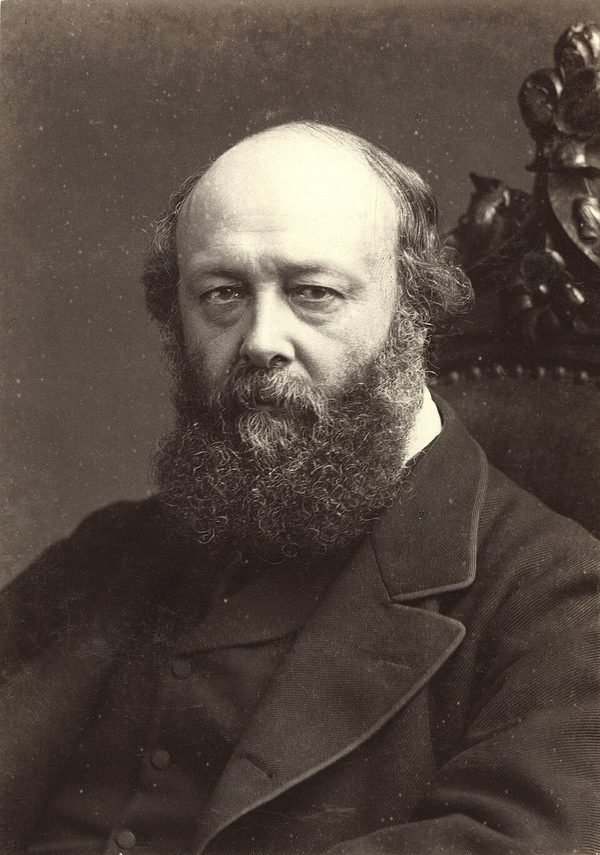
Robert Gascoyne-Cecil, 3rd Marquess of Salisbury
1830–1903 · British Conservative prime minister
Illness: Prosopagnosia (face blindness) and fragile health
More about: Prosopagnosia
Robert Gascoyne-Cecil, 3rd Marquess of Salisbury, was a British Conservative statesman, known as Lord Salisbury. He served three times as prime minister, for more than thirteen years in total, and he is one of the central figures of the Victorian era. Much less is documented about his health than about his political career, so any medical claim about him should be treated with caution.
He had a fragile constitution from childhood. He was described as a weak and delicate boy, prone to illness, and his early years were unhappy. In the medicine of his time, general ailments were usually treated with rest and a change of air. This helps explain why his doctor advised him to travel for his health. Between 1851 and 1853 he toured the Cape Colony, Australia and New Zealand. The journey is said to have strengthened him and deepened his interest in the running of the British Empire.
Among the conditions recorded for him is prosopagnosia, or face blindness, a neurological disorder that makes it hard to recognise faces, including those of family and close friends, while eyesight and intelligence remain intact. There is no documented record of when it first appeared or how he experienced it. The term was not used until the twentieth century, so any retrospective diagnosis must be regarded as a hypothesis. Victorian doctors had no tests for visual memory and could probably only address his general symptoms.
If the diagnosis is correct, prosopagnosia would have complicated the personal side of a public life built on meetings and parliamentary relationships. The surviving evidence does not, however, allow us to say how it affected his decisions. What is documented is that his health worsened towards the end of his life. Widowed and unwell, he resigned in July 1902 and died in August 1903.
Key dates
- 1830 Born at Hatfield into a family of the high aristocracy. As a child he is weak and prone to illness.
- 1847 Enters Christ Church, Oxford, where he receives an honorary degree by noble privilege because of his poor health.
- 1851 His doctor advises him to travel for his health, and he sets out on a long tour of the British colonies.
- 1902 Resigns as prime minister, widowed and in serious ill health.
- 1903 Dies at Hatfield.
Curiosities and anecdotes
A degree for reasons of health
At Oxford he received an honorary grade in mathematics by noble privilege, rather than through ordinary examination, because of his poor health.
An unexpected congratulation
After a parliamentary debate in 1867, John Stuart Mill crossed the floor of the House of Commons to congratulate Lord Cranborne, an unusual gesture between political opponents.
Sources
Original Medicapedia text based on:

Last updated: 5 November 2026 · How Medicapedia is made
A project by Alejandro Rosàs Navarro, family physician and specialist in preventive medicine and public health. Spotted a mistake? Write to info@medicapedia.org.