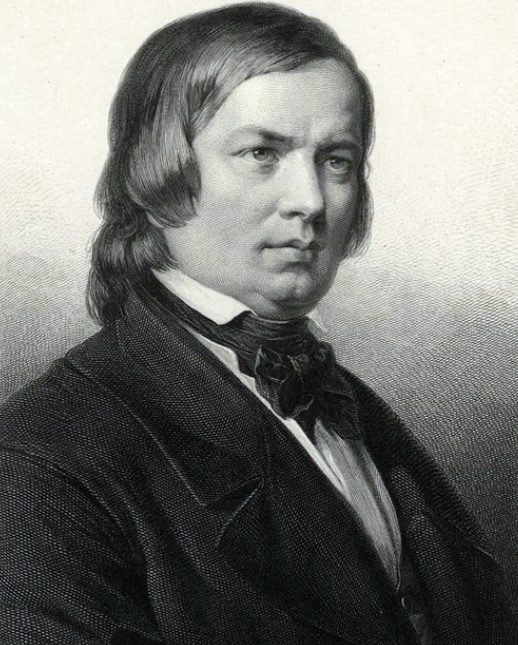
Robert Schumann
1810–1856 · German Romantic composer and pianist
Illness: Bipolar disorder
More about: Bipolar disorder
Also on: their music on Classicapedia
Robert Schumann (Zwickau, 1810 – Bonn, 1856) was one of the most representative composers of the Romantic period in music. Before devoting himself fully to music he had studied law, intending to become a virtuoso pianist. An injury to his right hand, whose cause is disputed, ended that concert career and led him to focus on composition, producing a wide body of work for piano, songs, symphonies and a single opera.
The first signs of his illness appeared in 1833, when the deaths of his brother Julius and his sister-in-law Rosalie during a cholera epidemic brought on a severe depressive episode. From 1834 the crises became more frequent: periods of deep melancholy and withdrawal alternated with phases of intense excitement, and over the years he developed delusions of being poisoned or threatened with metal objects, as well as hallucinations. For much of his life, however, his periods of lucidity were extraordinarily productive, and once he recovered he threw himself into composing with remarkable intensity, often to the point of exhaustion.
Medicine of his time had no precise psychiatric diagnoses. A range of treatments was tried, including allopathy, homeopathy and electrotherapy, without success. For a long time it was suspected that his mental decline was linked to syphilis or to the mercury used to treat it, but this idea was dismissed because his symptoms appeared in his youth, before any sign of infection could have appeared. Today the most widely accepted explanation is bipolar disorder, an illness that alternates episodes of very elevated mood with depressive episodes. Some researchers argue that mercury exposure may have worsened his condition, although this remains a debated hypothesis.
In 1854, after a suicide attempt, Schumann asked to be admitted to a psychiatric sanatorium near Bonn, where he died two years later, aged 46, without recovering. His illness did not silence his work, but it shaped his biography: his final years were dominated by instability, and critics have long debated whether his late works show a loss of inspiration. His legacy, however, remains central to the Romantic repertoire, and his music, full of characters and literary references, captured the emotional intensity of his era.
Key dates
- 1833 The deaths of his brother and sister-in-law trigger a severe depressive episode.
- 1834 Recurring crises begin, with phases of depression and excitement, and he founds the magazine Neue Zeitschrift für Musik.
- 1854 After a suicide attempt, he voluntarily enters a psychiatric sanatorium near Bonn.
- 1856 He dies at the sanatorium, aged 46, of pneumonia.
Sources
Original Medicapedia text based on:

Last updated: 5 November 2026 · How Medicapedia is made
A project by Alejandro Rosàs Navarro, family physician and specialist in preventive medicine and public health. Spotted a mistake? Write to info@medicapedia.org.