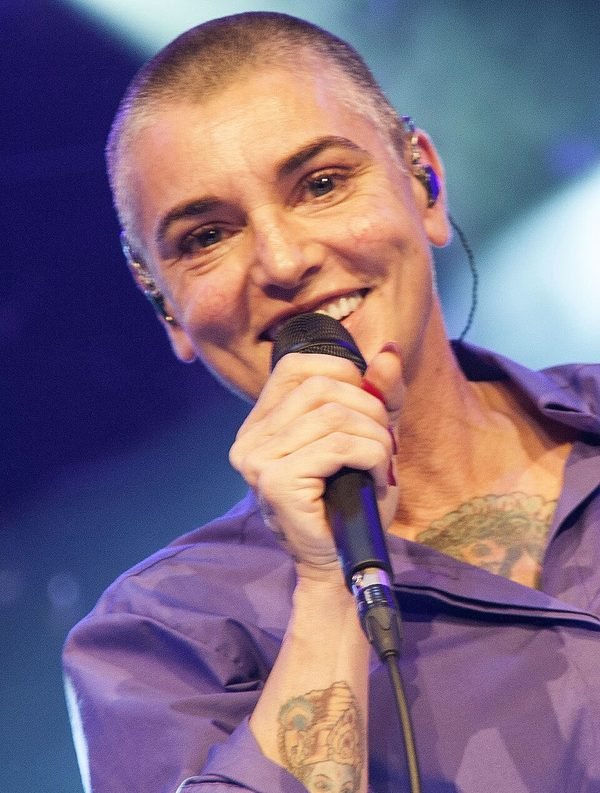
Sinéad O'Connor
1966–2023 · Irish singer, songwriter and activist
Illness: Mental health disorders and fibromyalgia
More about: Asthma, Chronic obstructive pulmonary disease, Bipolar disorder, Agoraphobia, Borderline personality disorder, Complex post-traumatic stress disorder, Fibromyalgia
Sinéad O'Connor (Dublin, 1966 – London, 2023) was an Irish singer, songwriter and activist whose voice and public image made her one of the most recognisable artists of the 1990s. For much of her life she lived with mental health difficulties, which she chose to discuss openly, earning both admiration and sharp criticism.
Her medical history records several diagnoses, some of them made or suggested by different professionals: bipolar disorder, agoraphobia (an intense fear of places that are hard to leave or where help is hard to reach), borderline personality disorder, complex post-traumatic stress disorder, which is linked to prolonged experiences of abuse, and fibromyalgia, a condition that causes widespread muscle pain and persistent tiredness. The bipolar diagnosis was later withdrawn. Today it is debated whether several of these conditions overlapped, something common in clinical practice, and retrospective explanations should be treated as hypotheses rather than certainties.
Her 2021 memoir, Rememberings, describes a childhood marked by abuse and an adolescence of constant distress. The death of her mother in a car accident in 1985 was, in her own words, devastating, despite a tense relationship between them. She spoke publicly about substance use and suicide attempts, and that account became a central part of her public image.
Information about her treatment is limited. In 1993 she explained that her work with the singing teacher Frank Merriman was the only therapy she was receiving at that time, a statement that shows how she sought support outside psychiatry. In her era, stigma meant many people said little about mental health problems, and she broke that silence.
Her health shaped her career. After the success of I Do Not Want What I Haven't Got, her career had ups and downs, and her changes of direction, including her conversion to Islam in 2018 and a retirement announced in 2021 and retracted days later, marked her image. In 2022 the suicide of her son Shane led her to cancel her tour. Her songs, especially those about pain and childhood, are still heard as a testimony to those struggles.
Key dates
- 1985 Her mother dies in a car accident, an event she described as devastating.
- 1993 She explains that her work with her singing teacher is the only therapy she is receiving at the time.
- 2021 She announces her retirement from music and retracts it days later, calling it a knee-jerk reaction.
- 2022 Her son Shane dies by suicide and she cancels her tour.
- 2023 She dies in London on 26 July.
Curiosities and anecdotes
A protest with lasting impact
In 1992 Time magazine named her the most influential woman of the year because of her protest on Saturday Night Live against sexual abuse committed within the Catholic Church.
A name with history
She was named after Sinéad de Valera, according to the accounts, a well-known figure in Ireland at the time.
Sources
Original Medicapedia text based on:

Last updated: 5 November 2026 · How Medicapedia is made
A project by Alejandro Rosàs Navarro, family physician and specialist in preventive medicine and public health. Spotted a mistake? Write to info@medicapedia.org.