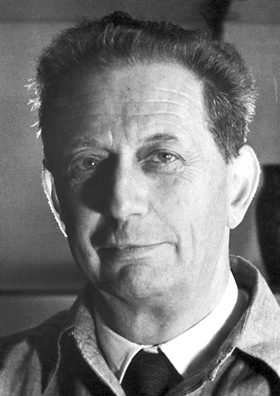
André Lwoff
1902–1994 · French biologist and physician of Russian-Polish origin
Also on: their science on Newtonpedia
André Michel Lwoff (Ainay-le-Château, 1902 – Paris, 1994) was a French biologist and physician of Russian-Polish origin whose work laid foundations for the genetics of microorganisms and for modern virology. He shared the 1965 Nobel Prize in Physiology or Medicine for discoveries about how genes are switched on and off inside cells, a key insight into how an organism controls its own genetic activity.
Lwoff was born in Ainay-le-Château, in the Allier department of the Auvergne region, into a Jewish family of Russian-Polish origin. His father was a psychiatrist and his mother an artist. He joined the Pasteur Institute in Paris at the age of nineteen and completed his doctorate in 1932. With a grant from the Rockefeller Foundation he moved with his wife and research partner, Marguerite Lwoff, to the Kaiser Wilhelm Institute for Medical Research in Heidelberg, where he worked under Otto Meyerhof on the development of flagellates, single-celled organisms that move using whip-like appendages. Another grant took him to the University of Cambridge in 1937. The following year he was appointed head of a department at the Pasteur Institute, where he carried out pioneering research on bacteriophages, the microbiota and poliovirus.
His best-known work concerned bacteriophages, viruses that infect bacteria. Lwoff observed that some bacteria carry a latent virus inside them that can remain silent for many generations before becoming active. He called this hidden virus a provirus, and the phenomenon is now known as lysogeny. His studies showed that the activity of these viral genes is controlled, and this principle helped François Jacob and Jacques Monod build their model of gene regulation, for which the three men were awarded the Nobel Prize.
In 1962, together with Robert Horne and Paul Tournier, he proposed one of the first formal systems for classifying viruses, known as the LHT system. Until then, viruses had been grouped in an unsystematic way. Their framework allowed the accumulated knowledge to be ordered and laid the groundwork for the later work of the International Committee on Taxonomy of Viruses, created a few years afterwards.
His career brought other honours, including the Leeuwenhoek Medal, the Charles-Léopold-Mayer Prize and election as a Foreign Member of the Royal Society in 1958. He served for two years from 1974 as president of the Federation of European Microbiological Societies. He worked almost always alongside his wife, although he gained considerably more public recognition. He was also a humanist opposed to capital punishment. His legacy endures in virology, in microbial genetics and in the name of the bacterium Acinetobacter lwoffii.
Contributions
- LHT system: a virus classification proposed in 1962 with Horne and Tournier, which brought order to a previously scattered field.
- Lysogeny and proviruses: a description of latent viruses within bacteria that could become active much later.
- Gene regulation: work that, together with Jacob and Monod, explained how cells control the activity of their genes.
- Bacteriophages: pioneering research on viruses that infect bacteria, carried out at the Pasteur Institute.
Curiosities and anecdotes
A bacterium named after him
The bacterium Acinetobacter lwoffii bears his name in his honour. It is a lasting reminder of his mark on microbiology.
An award in his name
The Federation of European Microbiological Societies awards the FEMS-Lwoff Award in microbiology, which is named after him.
Sources
Original Medicapedia text based on:

Last updated: 5 November 2026 · How Medicapedia is made
A project by Alejandro Rosàs Navarro, family physician and specialist in preventive medicine and public health. Spotted a mistake? Write to info@medicapedia.org.