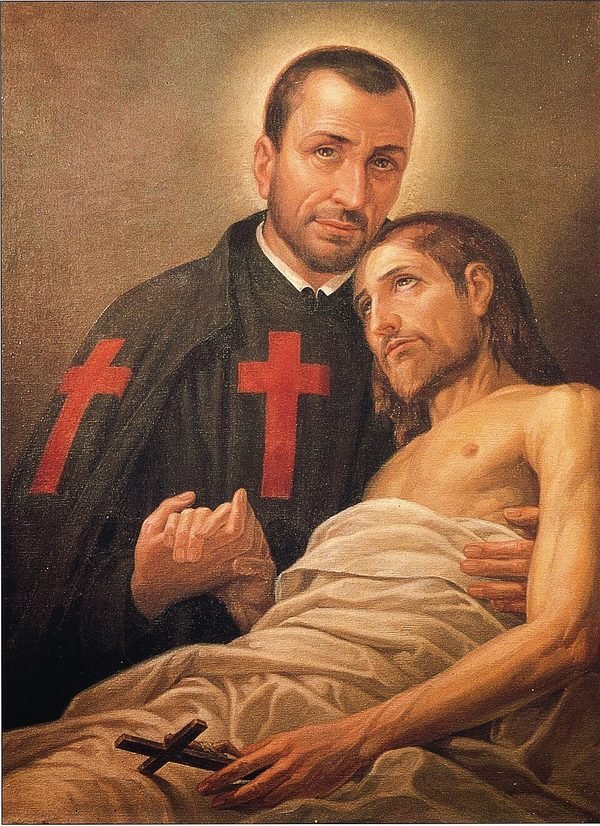
Camillus de Lellis
1550–1614 · Italian priest, founder of the Camillians and patron of the sick
Camillus de Lellis (25 May 1550 - 14 July 1614) was an Italian Catholic priest who founded the Camillians, a religious order devoted to the care of the sick. He is venerated as a saint, and his work is an early example of organized hospital care built on the personal commitment of its members.
He was born at Bucchianico, then part of the Kingdom of Naples, to a mother who was already near sixty. His father, an officer in several armies, was rarely at home, and after his mother died in 1562 Camillus grew up with little supervision. He followed his father on military campaigns and fought against the Turks with the Venetian army. When his regiment was disbanded in 1575, gambling had left him penniless. A leg wound that would not heal led to his rejection by the Capuchins, but that same year he underwent a religious conversion.
He worked at the San Giacomo hospital in Rome, where he rose to become superintendent and noticed how carelessly patients were treated. Encouraged by his confessor, Philip Neri, he planned a group of men devoted to caring for the sick with compassion. He studied for the priesthood late in life and was ordained in 1584. The following year the group was organised as a community, and in 1586 Pope Sixtus V gave it formal recognition. Gregory XIV later raised it to the rank of a religious order.
The Camillians spread to Naples, Milan and other cities, serving plague victims and wounded soldiers. Camillus set strict rules, including waiting a set time after an apparent death to prevent premature burial. He died in Rome in 1614. He was beatified in 1742 and canonised in 1746 by Benedict XIV. In 1886 Leo XIII named him patron of hospitals and of the sick.
Contributions
- Founding of the Camillians: he created a religious congregation of nurses devoted to caring for abandoned sick people.
- Red cross on the habit: his members wore a large red cross on their garments, a symbol now associated with charity and service.
- Fourth vow: the order added a special vow to serve the sick even at risk to one's own life.
- Patronage: he was declared patron of the sick, of hospitals and of healthcare workers.
Curiosities and anecdotes
A red cross before the Red Cross
His members wore a large red cross on their habit, a emblem often linked to the later Red Cross.
A cross that spoke
According to tradition, a cross spoke to him and told him the work was not his but God's. This phrase has become a motto associated with him.
Sources
Original Medicapedia text based on:

Last updated: 5 November 2026 · How Medicapedia is made
A project by Alejandro Rosàs Navarro, family physician and specialist in preventive medicine and public health. Spotted a mistake? Write to info@medicapedia.org.