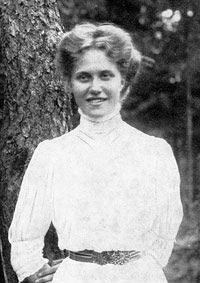
Elsa Brändström
1888–1948 · Swedish nurse and philanthropist known as the "Angel of Siberia"
Elsa Brändström (Saint Petersburg, 1888 – Cambridge, Massachusetts, 1948) was a Swedish nurse and philanthropist who devoted much of her life to prisoners of war during the First World War. She became known as the "Angel of Siberia" for her work with German and Austrian soldiers held captive in Russia.
The daughter of a Swedish military officer posted to the Swedish legation in Saint Petersburg, she spent part of her youth in Sweden and trained as a teacher in Stockholm before returning to Russia. When the war broke out she volunteered as a nurse. In 1915 she travelled to Siberia with the Swedish Red Cross, together with her friend Ethel von Heidenstam, to introduce basic medical treatment in the camps, where many prisoners died of cold, hunger and typhoid fever. After the Russian Revolution the Soviet authorities withdrew her work permit, and in 1920 she was arrested in Omsk and accused of espionage. A death sentence was pronounced but later revoked.
After her release she returned to Germany, where she looked after former prisoners and their families. She bought the Schreibermühle mill to help them rebuild their lives through farming, and founded the Neusorge children's home for the sons and daughters of soldiers who had died. In the 1930s she moved to the United States, where she helped refugees, and during the Second World War she raised funds for women and children in need in Germany. She died of bone cancer in 1948. She was nominated five times for the Nobel Peace Prize.
Contributions
- Care for prisoners of war: she visited captive camps in Siberia and promoted basic medical care for German and Austrian soldiers.
- Schreibermühle and Neusorge: she set up a centre to help former prisoners rebuild their lives and a home for the children of soldiers who had died.
- Support for refugees: in the United States she assisted German and Austrian refugees and opened a restaurant that gave work to newcomers.
- International recognition: she was honoured in Germany and Austria with streets and schools, and a monument in her memory was unveiled in Vienna in 1965.
Curiosities and anecdotes
A nickname born in the camps
She was called the "Angel of Siberia" after the German and Austrian prisoners who saw her, struck by her blue eyes and fair hair. The nickname spread and became part of her identity.
A Nobel nomination
She was nominated five times for the Nobel Peace Prize, under the title "Heroine of Peace".
Sources
Original Medicapedia text based on:

Last updated: 5 November 2026 · How Medicapedia is made
A project by Alejandro Rosàs Navarro, family physician and specialist in preventive medicine and public health. Spotted a mistake? Write to info@medicapedia.org.