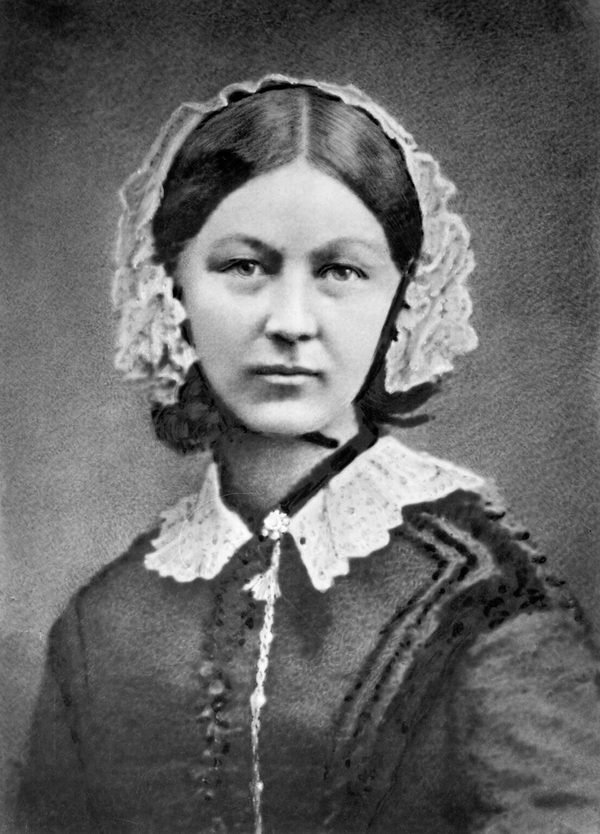
Florence Nightingale
1820–1910 · English nurse, statistician and health reformer
Florence Nightingale was born on 12 May 1820 at the Villa Colombaia, near the Porta Romana in Florence, where her parents were staying during a tour of Europe. Like her older sister Frances Parthenope, she was named partly after the place of her birth, and the family returned to England the following year. They spent Florence's childhood between Lea Hurst in Derbyshire and Embley Park in Hampshire. Her father, William Edward Nightingale, had been born William Edward Shore and took the Nightingale name after inheriting property from a distant relative. Her mother, Frances Smith, was the daughter of the abolitionist and Unitarian William Smith. William took charge of his daughters' education in a way that was unusual for the time, teaching them Latin, Greek, mathematics, history, several languages and music. Florence showed an early gift for mathematics, a skill that would later help her work with health data.
In February 1837, at sixteen, Nightingale recorded what she later described as the first of several calls from God to devote herself to the service of others. The call did not say what form that service should take, and it took years for her to settle on nursing. Her mother and sister strongly opposed the idea, since they expected her to marry and lead the social life expected of a woman of her class. The politician and poet Richard Monckton Milnes, one of her most persistent suitors, proposed marriage after a long courtship, but she refused, fearing that marriage would stop her from pursuing her vocation. In Rome in 1847 she met Sidney Herbert, a newly married politician who became a close friend for life and a decisive ally in her projects. Between 1849 and 1850 she travelled through Greece and Egypt with Charles and Selina Bracebridge. Her letters and diaries from these journeys show a curious, observant woman with a real gift for writing. In one of her diary entries she wrote that God had called her to do good without seeking reputation.
In 1850 she visited the Lutheran community at Kaiserswerth, in Germany, led by Pastor Theodor Fliedner, where deaconesses cared for the sick and the poor. There she received four months of basic medical training, which was very limited by modern standards but laid the groundwork for her later work. She published an anonymous account of the experience in 1851. On 22 August 1853 she became superintendent of the Institute for the Care of Sick Gentlewomen in Upper Harley Street, London, a post she held until October 1854. Her father provided her with an annual income that allowed her to live comfortably and pursue her career without depending on a salary.
To understand her work, it helps to recall how hospital care looked in the mid-nineteenth century. Nursing was not a regulated profession. Those who looked after the sick were often untrained women, frequently former servants or widows who needed paid work. Hospitals were places of last resort, with poor ventilation, inadequate drains and irregular cleanliness. The prevailing theory linked many illnesses to foul air or miasmas, and it was not yet widely accepted that microorganisms caused infection. Surgeons worked without the antiseptic methods that would become common decades later. Against this background, the idea that nursing could be organised, measured and taught was genuinely new.
The Crimean War, in which the Russian Empire faced a coalition of Britain, France, the Ottoman Empire and Sardinia, was the setting that made Nightingale famous. News of the suffering of wounded soldiers reached Britain and created strong public pressure. Sidney Herbert, then Secretary at War, made it possible for Nightingale to travel to the region with a group of nurses. On 21 October 1854 she left with thirty-eight volunteer nurses, among them her aunt Mai Smith, and in the first days of November she reached the Selimiye Barracks at Scutari, the main British base on the Asian side of the Bosphorus, near Constantinople. She found wounded men being treated by an overstretched medical staff, with medicines in short supply, hygiene badly neglected and infections common, many of them fatal.
For a long time it was repeated that her management cut the death rate from 42 per cent to 2 per cent. That figure appeared in the first edition of the Dictionary of National Biography but not in the second, and the available data do not support it. What is documented is that 4,077 British soldiers died during her first winter at Scutari, and that infectious diseases such as typhus, typhoid, cholera and dysentery killed ten times more men than wounds sustained in battle. Overcrowding and defective sewers made matters worse. In March 1855, almost six months after her arrival, the British government sent a Sanitary Commission to Scutari, which cleared the sewers and improved ventilation. From then on the death rate fell quickly. During the war, however, Nightingale attributed most deaths to poor diet, lack of supplies and the exhaustion of the soldiers, and she never claimed credit for the reduction. Back in London she gathered evidence for the Royal Commission on the Health of the Army and came to believe that the poor living conditions in the hospitals had caused much of the mortality. That experience directed her later work towards sanitation and the design of hospitals.
During the conflict, an article in The Times in February 1855 described her work in terms that made her famous. After the war, the nickname 'the lady with the lamp' spread, helped by Henry Wadsworth Longfellow's poem 'Santa Filomena', published in 1857. The image of a woman walking the wards at night with a lamp became a symbol of nursing, although it simplified a far more complicated career. There were rivalries too. Mary Seacole, who ran a hotel and care base for soldiers near the front, was treated coolly by Nightingale's circle, and accounts from the period do not fully agree on why that distance arose.
In November 1855 the Nightingale Fund was set up to train nurses, with Sidney Herbert as honorary secretary. By 1859 it had provided Nightingale with £45,000. With that money she opened the Nightingale Training School at St Thomas' Hospital in London on 9 July 1860. It was the first formal programme for training nurses and the first secular nursing school in the world; today it is part of King's College London. The first nurses trained there began work in May 1865 at the Liverpool Workhouse Infirmary. In 1859 she had published Notes on Nursing, a short book written for people who cared for the sick at home. It became the foundation of the curriculum at her school and of others that followed its model. She devoted much of the rest of her life to organising nursing as a profession and to promoting sanitation and hospital design.
Nightingale was also an innovator in presenting data. She understood statistics well and used them to persuade politicians and civil servants. She developed the polar area diagram, known as the Nightingale rose diagram, which is equivalent to a modern circular histogram and showed the causes of death at the military hospital in a visual way. She used these charts in her reports to Parliament so that the facts could be grasped even by people who struggled with conventional tables. In 1859 she became the first woman member of the Royal Statistical Society and later an honorary member of the American Statistical Association. In her last years she directed a large statistical study of sanitary conditions in rural India and pushed for improvements in medical care there.
Her health was fragile. From 1857 she suffered from depression and long periods in bed, and the cause of these ailments remains debated. A 2008 biography argues that she may have had chronic brucellosis, contracted after a fever she had in Crimea, while other writers have suggested chronic fatigue syndrome or myalgic encephalomyelitis. None of these explanations is confirmed. Even so, she continued to work from home through letters, reports and advice, and she directed hospital planning and social reform. Her work spread across Britain and beyond. She is often said to have died rejecting the germ theory of disease. The biographer Mark Bostridge argues instead that she opposed contagionism, the idea that diseases could only be passed on by touch, and that in the early 1880s she advocated strict precautions designed to destroy germs.
Her relationships were complex. Although her reforms improved the lives of women, she preferred the company of influential men and often spoke of herself in masculine terms. She nevertheless kept lasting friendships with women, among them the Irish nun Mary Clare Moore, with whom she had worked in Crimea, and Mary Clarke, whom she had met in 1837. Some historians believe she remained celibate throughout her life, out of devotion to her vocation.
Her final years were marked by blindness and declining mental strength, and she wrote very little in her last decade. She died peacefully in her sleep on 13 August 1910, aged ninety, at her home in London. She declined burial in Westminster Abbey and was laid to rest in the churchyard of St Margaret's Church in East Wellow, Hampshire, near Embley Park, under a simple memorial bearing her initials.
Her legacy is wide-ranging. In 1907 she became the first woman to receive the Order of Merit of the United Kingdom, and in 1883 she became the first recipient of the Royal Red Cross. The Nightingale Pledge, taken by nurses on graduation, was created in her honour in 1893, and International Nurses Day is celebrated on her birthday. In 1912 the International Committee of the Red Cross established the Florence Nightingale Medal. Henri Dunant, the founder of the Red Cross, acknowledged that her work in Crimea had inspired him. Her influence can be seen in the idea of training carers properly and in the conviction that sanitation saves lives, though the history of nursing is also the story of many people who made it possible. Today her figure is discussed with more nuance: her statistics, methods and silences are re-examined, but her role in the professionalisation of nursing remains central.
Contributions
- St Thomas’ nursing school: founded in 1860, it laid the foundations for professional nurse training and was the first secular school of its kind.
- Sanitary reform at Scutari: better cleaning and ventilation helped reduce mortality at the military hospital after her arrival.
- The rose diagram: her graphical presentation of health data is still used in data visualisation.
- Hospital design: her evidence for the Royal Commission on the Health of the Army encouraged better ventilated and cleaner hospitals.
Curiosities and anecdotes
An owl named Athena
During her travels in Greece she rescued a young owl from children who were tormenting it, and named it Athena. She often carried it in her pocket until it died, shortly before she left for Crimea.
The rose diagram
Her polar area diagram, known as the Nightingale rose, is equivalent to a modern circular histogram and is still used to display data.
Sources
Original Medicapedia text based on:

Last updated: 5 November 2026 · How Medicapedia is made
A project by Alejandro Rosàs Navarro, family physician and specialist in preventive medicine and public health. Spotted a mistake? Write to info@medicapedia.org.