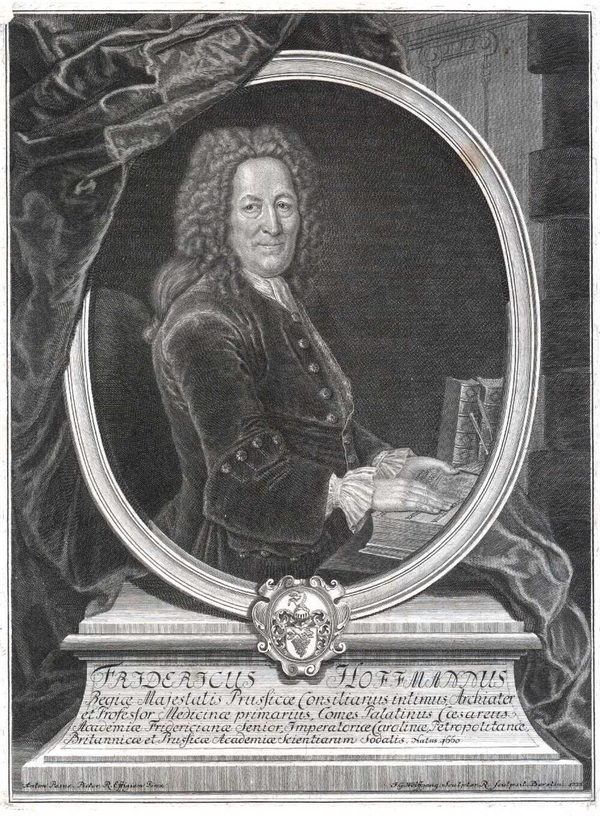
Friedrich Hoffmann
1660–1742 · German physician and chemist, a pioneer of iatrochemistry and mechanical medicine
Friedrich Hoffmann (Halle, 1660 – Halle, 1742) was a German physician and chemist whose work joined clinical practice with a mechanical explanation of the body. He matters because he helped bring chemistry into the study of disease and into the therapy of his time.
He came from a family connected with medicine for generations. He attended the local grammar school, where he developed a taste for mathematics that he later credited with much of his success. He began studying medicine at the University of Jena and then trained in chemistry at Erfurt under Kasper Cramer. After earning his doctorate at Jena, he began to teach, but overwork began to affect his health.
He practised in Minden and Halberstadt, and in 1693, shortly after the University of Halle was founded, he was appointed professor of medicine and natural philosophy. He spent most of his life there, served three times as rector, and left the city only between 1708 and 1712, when he was royal physician in Berlin. His reputation spread across Europe, and in 1720 he was elected Fellow of the Royal Society.
His thinking rested on a mechanical view: he regarded disease as a disturbance of the tone of the tissues and of the body as a whole, and he gave the nervous system a regulating role. His main work, Medicina rationalis systematica, published in 1730, was translated into French and reached many editions. At the suggestion of Robert Boyle he studied mineral waters, and he argued that almost all springs contained alkaline salts and carbonic acid. Some of his preparations, such as compound spirit of ether and the drops that bear his name, were used for a long time. He is also credited with being one of the first to describe appendicitis. Georg Ernst Stahl disagreed with the general use of mineral waters that Hoffmann recommended. His legacy is that of a bridge between chemistry, physiology and eighteenth-century clinical medicine.
Contributions
- Medicina rationalis systematica His main work, published in 1730, summarises his medical system and was translated into French.
- Study of mineral waters He analysed many German springs and promoted their therapeutic use and scientific study.
- Mechanical view of disease He explained disorders as changes in the tone of the body, using physical and chemical principles.
- Regulating role of the nervous system He recognised that the nervous system controls the body's functions.
Curiosities and anecdotes
An early study of charcoal fumes
He is credited with the first scientific investigation of carbon monoxide poisoning caused by burning charcoal. In 1716 he published a work on the fatal effects of charcoal vapour.
A book on witchcraft
Together with his student Gottfried Büching, he wrote De Potentia Diaboli in corpore, a work on witchcraft.
Sources
Original Medicapedia text based on:

Last updated: 5 November 2026 · How Medicapedia is made
A project by Alejandro Rosàs Navarro, family physician and specialist in preventive medicine and public health. Spotted a mistake? Write to info@medicapedia.org.