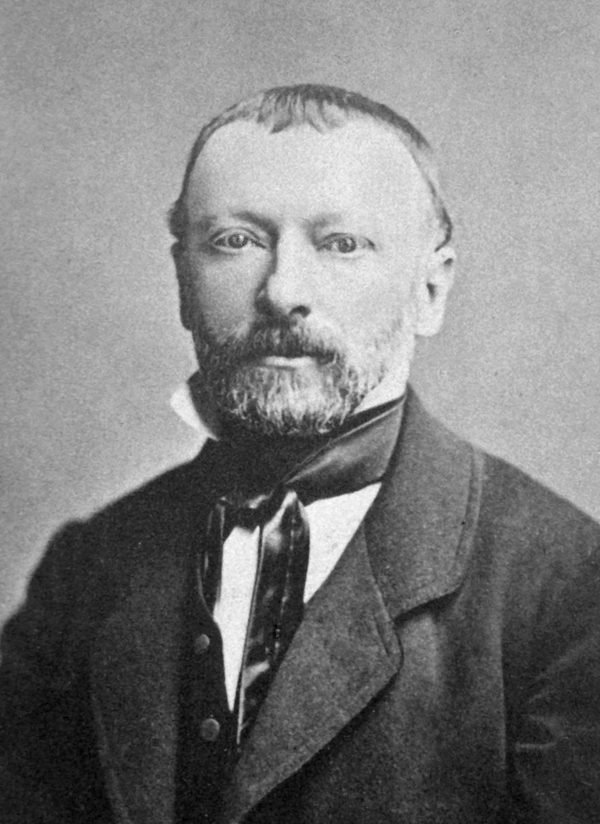
Ludwig Traube
1818–1876 · German physician, pioneer of experimental pathology
Ludwig Traube (Ratibor, Silesia, 1818 – Berlin, 1876) was a German physician regarded as one of the founders of experimental pathology in Germany. His work combined bedside clinical observation with experiments on animals, an approach that was still uncommon in German medicine at the time and helped give the discipline a firmer scientific footing.
The son of a Jewish wine merchant, he left the gymnasium in his hometown in 1835 and studied medicine in Breslau, Berlin and Vienna. His teachers included Jan Evangelista Purkyně and Johannes Müller. He earned his doctorate in 1840 with a thesis on pulmonary emphysema, an abnormal enlargement of the lung's air sacs. After further training in Vienna under Rokitansky and Škoda, he worked in Berlin as a physician for the poor and, in 1849, became the first civilian assistant of Johann Lukas Schönlein at the Charité hospital.
His career was slowed by anti-Jewish prejudice, which kept him from advancing as quickly as his work warranted. Even so, he became an adjunct professor in 1857, a full professor in 1862 and, in 1872, a professor at the University of Berlin. He led the lung department at the Charité and later the propaedeutic clinic. He collaborated with Rudolf Virchow on the influential journal of experimental pathology. His research covered the physiology of breathing, the regulation of body temperature and the scientific basis for digitalis use in heart disease, and his studies on the links between heart and kidney disease are still cited. He died of coronary disease. Several clinical signs bear his name.
Contributions
- Experimental pathology: one of the founders of this field in Germany, studying disease mechanisms through animal experiments.
- Auscultation and percussion: he refined these physical examination methods, which involve listening to and tapping the chest to assess the organs.
- Clinical charts: he introduced the combined recording of temperature, pulse and breathing rate into clinical practice.
- Digitalis and the heart: he gave a scientific basis to digitalis therapy and studied the links between heart and kidney disease.
Curiosities and anecdotes
A scientific family
His brother Moritz Traube was a pioneer of physiological chemistry. The family produced several other scholars and physicians.
Signs named after him
Several findings from auscultation and clinical examination bear his name, such as Traube's pulse and Traube's space.
Teachers and pupils
Teachers
- Johannes Peter Müller 1801–1858
- Johann Lukas Schönlein 1793–1864
- Jan Evangelista Purkyně 1787–1869
Pupils
- Ernst von Leyden 1832–1910
- Hermann Senator 1834–1911
- James Israel 1848–1926
Sources
Original Medicapedia text based on:

Last updated: 5 November 2026 · How Medicapedia is made
A project by Alejandro Rosàs Navarro, family physician and specialist in preventive medicine and public health. Spotted a mistake? Write to info@medicapedia.org.