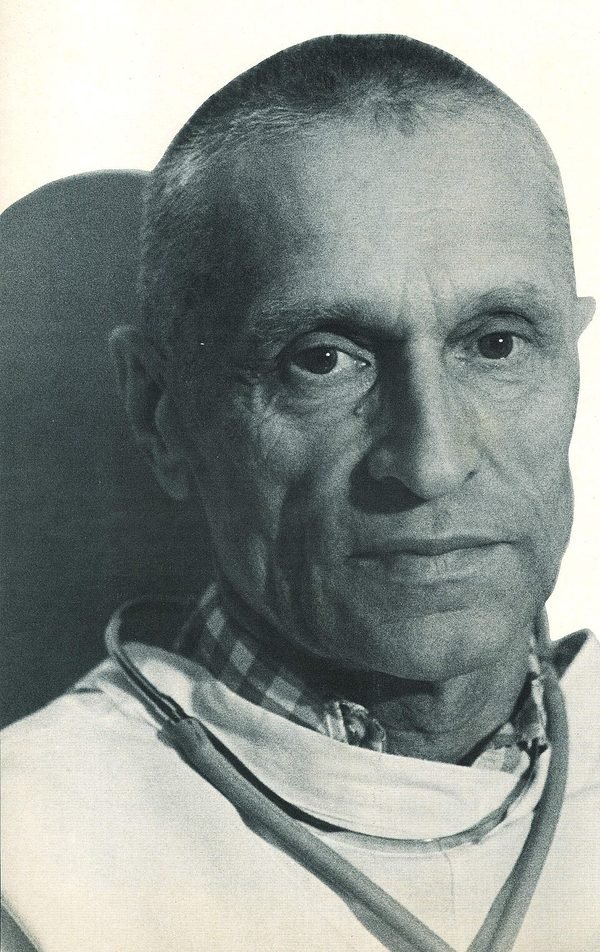
Mykola Amosov
1913–2002 · Soviet and Ukrainian surgeon, pioneer of heart surgery
Mykola Amosov (1913-2002) was a surgeon of Russian origin who worked most of his career in Ukraine, then part of the Soviet Union. He is remembered for his contributions to thoracic surgery and, above all, to heart surgery, as well as for his interest in applying cybernetics to biology and medicine. His career illustrates how twentieth-century medicine drew on engineering and technology to treat conditions once considered beyond reach.
He was born on 6 December 1913 in a village of the Novgorod Governorate, in the Russian Empire, into a peasant family. Before studying medicine he trained as a mechanic and worked for a time at an electric power station. He graduated in medicine at Arkhangelsk in 1939, and during the Second World War he served at the front as chief surgeon of a mobile field hospital on Ukrainian territory. After the war he led surgery in the Bryansk region, where he began to devote himself intensively to thoracic surgery, and in 1953 he defended his doctoral thesis.
In 1952 he was invited to the Kyiv Institute of Tuberculosis to lead a newly created thoracic surgery clinic. There he promoted the spread of lung surgery across the country, work that earned him the Lenin Prize in 1961. His focus then shifted to the heart. In 1955 he began surgical treatment of heart disease in Ukraine and, some years later, helped introduce extracorporeal circulation into Soviet practice, a technique that diverts blood temporarily through a machine so the heart can be stopped during an operation. In 1965 he developed an anti-thrombotic heart valve prosthesis, designed to reduce the formation of clots.
His clinic carried out thousands of operations, and in 1983 it was reorganized as the Kyiv Research Institute of Cardiovascular Surgery, of which he was the first director. Amosov also founded departments for training specialists and for decades headed the Department of Biological Cybernetics at the Institute of Cybernetics, where he studied self-regulation of the heart and computer models of mental functions. He was also a popular writer: his book The Thoughts and the Heart, published in 1965, reached a wide readership. His legacy includes an institute bearing his name, a street in Kyiv and a prize of the National Academy of Sciences of Ukraine for work in cardiovascular surgery.
Contributions
- Lung surgery: promoted lung operations in Ukraine through the Kyiv clinic.
- Extracorporeal circulation: introduced into Soviet practice the method that temporarily takes over the heart and lungs' function during surgery.
- Anti-thrombotic valve: developed a heart valve prosthesis designed to reduce clot formation.
- Biological cybernetics: studied heart self-regulation and computer models of mental functions.
Curiosities and anecdotes
A widely read book
His book The Thoughts and the Heart, published in 1965, sold millions of copies. Amosov was also a keen advocate of physical exercise.
A syndrome named after a pupil
One of his disciples, Victor Skumin, described a previously unknown disorder, now called Skumin syndrome, affecting the central nervous system of some patients with prosthetic heart valves.
Sources
Original Medicapedia text based on:

Last updated: 5 November 2026 · How Medicapedia is made
A project by Alejandro Rosàs Navarro, family physician and specialist in preventive medicine and public health. Spotted a mistake? Write to info@medicapedia.org.