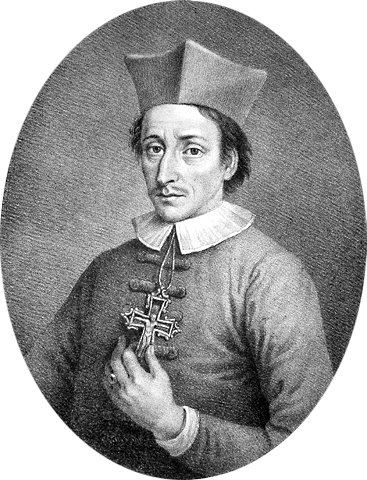
Nicolas Steno
1638–1686 · Danish physician, anatomist and naturalist, pioneer of geology
Also on: their science on Newtonpedia
Nicolas Steno (Niels Steensen in Danish) was a Danish physician, anatomist and naturalist, born in Copenhagen in 1638 and who died in Schwerin in 1686. He is regarded as one of the founders of modern geology, and late in life he became a Catholic bishop and missionary. His significance lies in combining direct observation of nature with an experimental approach that was uncommon in his time.
Born into a Lutheran family, Steno was a sickly child who spent much of his early years apart from other children, listening to the religious debates of adults. After a classical education with the poet and scientist Ole Borch, he entered the University of Copenhagen in 1656 to study medicine. A war with Sweden, which besieged the city, disrupted his studies, and in 1659 he left for the continent with a letter of recommendation from Thomas Bartholin, the anatomist who had described the lymphatic vessels.
In Amsterdam, in the laboratory of the physician Gerard Blaes, Steno dissected a sheep's head and, while probing a small duct, felt the tip of his probe move freely in a cavity no one had described. That duct, which now bears his name, carries saliva from the parotid gland. Blaes played down the discovery and later sought credit for it, so Steno set out to expose his rival's errors on the dissection table. Over the following year he wrote a detailed study of the glands of the head, including the first complete description of the lacrimal apparatus.
His work on muscles led him to propose geometrical models of muscle contraction, and his public dissection of the pineal gland showed that it did not move as Descartes had assumed, reflecting his distrust of inherited explanations. In Paris in 1665 he gave a lecture on the brain that opened by admitting he knew nothing about it, since what had been written so far seemed to him contradictory.
In 1666 he settled in Florence, serving Grand Duke Ferdinando II de' Medici and working with the Accademia del Cimento. That October he was asked to dissect a large shark caught off the Tuscan coast. Comparing its teeth with the glossopetrae, the so-called tongue stones, he argued that these fossils were the remains of marine animals. This study launched his geological interest, and in 1669 he published De solido intra solidum, which set out principles of stratigraphy such as the superposition of layers.
Around 1667 he converted to Catholicism, and his scientific interests gradually gave way to theology. He was ordained a priest in 1675 and appointed vicar apostolic of the Nordic missions and titular bishop of Titopolis. He died in Schwerin in 1686. John Paul II beatified him in 1988.
Contributions
- Steno's duct The duct that carries saliva from the parotid gland, identified during his studies in Amsterdam.
- Principles of stratigraphy Rules on the order in which rock layers form, which remain the basis of the discipline.
- Fossils as remains of living creatures He argued that glossopetrae were petrified shark teeth, an idea that clashed with the prevailing view.
- Study of muscle contraction He proposed geometrical models to explain how a muscle changes shape without changing its volume.
Curiosities and anecdotes
A name in several languages
According to the sources, he published his scientific work in Latin as Nicolaus Steno, signed his French letters as Nicolas Sténon and his Italian ones as Niccolò Stenone. His birth name was Niels Steensen.
The shark's head
According to some accounts, the grand duke ordered the animal's head to be sent to Steno for study. Steno dissected it and published his findings in 1667.
Fossils and living things
Steno was not the only one to think fossils came from living organisms. The Englishman Robert Hooke argued a similar idea around the same time.
Sources
Original Medicapedia text based on:

Last updated: 5 November 2026 · How Medicapedia is made
A project by Alejandro Rosàs Navarro, family physician and specialist in preventive medicine and public health. Spotted a mistake? Write to info@medicapedia.org.