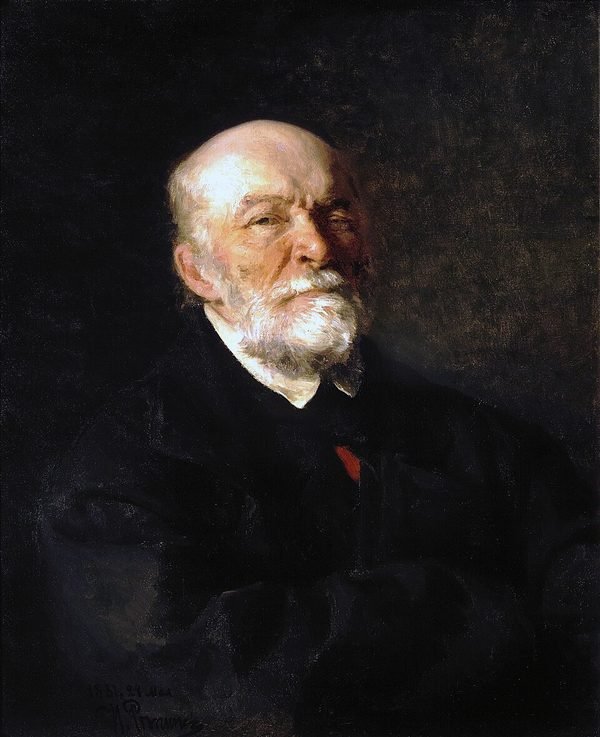
Nikolai Ivanovich Pirogov (Moscow, 1810 – Vinnytsia, 1881) was a prominent Russian scientist, physician and educator, and a corresponding member of the Russian Academy of Sciences from 1847. He is considered the founder of field surgery, the practice of operating near the battlefield, and he was one of the first surgeons in Europe to use ether as an anaesthetic. His name endures in medical history for his surgical techniques and for his work organising care for the wounded.
Born in Moscow into a large family, he learned to read at an early age and mastered several languages as a child. His father's death in 1824 left the household without income. Pirogov first intended to become a civil servant, but the family doctor, Yefrem Mukhin, a professor of anatomy and physiology at Moscow University, persuaded the authorities to admit him to medical studies at the age of fourteen. After completing his studies in 1828, he chose surgery. He earned his doctorate at Dorpat with a thesis on ligation of the aorta, and continued his training in Göttingen and Berlin, where he worked alongside respected surgeons. In 1836 he became a professor at Dorpat, at only about twenty-five years old.
His interest centred on anatomy as applied to surgery. He studied arteries and fasciae, and in 1840 he took up the chair of surgery at the Military Medical Academy in Saint Petersburg. There he introduced anatomical study on frozen cadavers, which allowed him to map the relations between organs and tissues in three dimensions; this work led to his topographical anatomy atlas, published between 1851 and 1854. In 1847 he used ether as an anaesthetic, at a time when operations were carried out with severe pain for the patient. He also investigated cholera from 1848.
During the Crimean War he worked as a field surgeon and reached Simferopol in December 1854. There he developed a foot amputation technique that preserves part of the heel, known as the Pirogov amputation, and he built on the work of Louis-Joseph Seutin with plaster casts for broken bones. He also devised a triage system that sorted wounded soldiers into five categories, and supported an organised corps of volunteer nurses, inspired by the efforts of Florence Nightingale. After the war he left the Academy and turned to education, arguing for schooling for the poor, non-Russians and women, and opposing early specialisation. Later he settled on his estate at Vinnytsia, where he treated local peasants and learned Ukrainian as a mark of respect. He died at the estate in 1881. His body, embalmed with a technique of his own invention, rests in a church in the town.
His legacy lives on in the scientific school he founded, in numerous institutions bearing his name and in several anatomical structures that carry his surname.
Contributions
- Field surgery: laid the foundations of surgical care near the front line.
- Topographic anatomy: his atlas linked the structures of the body through sections of frozen cadavers.
- Pirogov amputation: a foot amputation technique that preserved part of the heel to allow walking.
- Five-category triage: a method for ordering care for the wounded by severity.
- Use of ether: used ether anaesthesia in operations from 1847.
Curiosities and anecdotes
An embalmed body
His body was embalmed using a technique he developed himself and is kept in a church in Vinnytsia, where it can be seen by the public.
An asteroid named after him
Asteroid (2506) Pirogov is named in his honour.
Teachers and pupils
Teachers
- Karl Ferdinand von Graefe 1787–1840
Sources
Original Medicapedia text based on:

Last updated: 5 November 2026 · How Medicapedia is made
A project by Alejandro Rosàs Navarro, family physician and specialist in preventive medicine and public health. Spotted a mistake? Write to info@medicapedia.org.