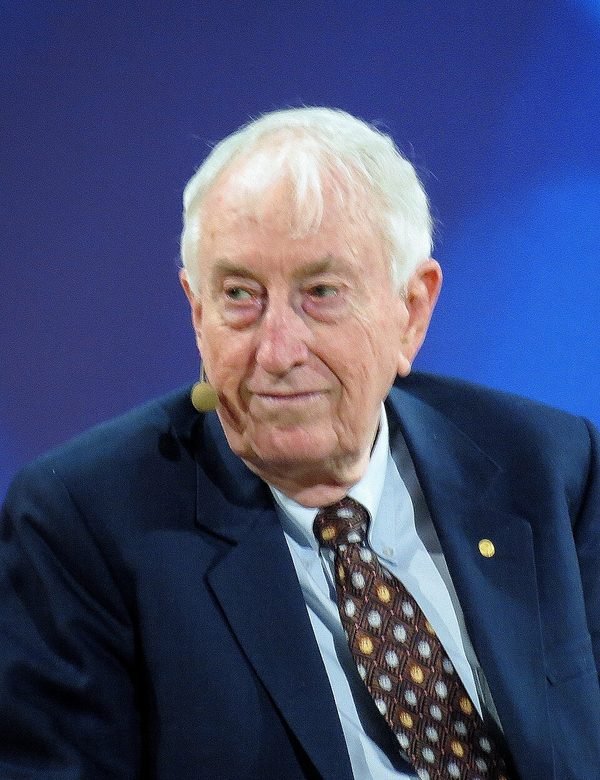
Peter C. Doherty
1940 · Australian veterinarian and immunologist, Nobel Prize in Physiology or Medicine in 1996
Peter Charles Doherty was born on 15 October 1940 in Sherwood, a suburb of Brisbane, the capital of the Australian state of Queensland. He grew up in Oxley, another part of the same city, and attended Indooroopilly State High School, which today has a lecture theatre named after him. The son of Eric Charles Doherty and Linda Doherty, née Byford, his early path did not point directly towards human medicine. He graduated in veterinary science from the University of Queensland in 1962. That training matters for understanding his later work. Many of the experiments that brought him fame were carried out with laboratory animals, and his knowledge of infectious disease in animals drew him towards the study of viruses and of the body's response to them.
After graduating he worked as a rural veterinary officer for the Queensland Department of Agriculture and Stock. He then moved into laboratory work at the department's Animal Research Institute, where he met Penelope Stephens, a microbiology graduate. They married in 1965. In 1966 he obtained a master's degree in veterinary science, again from the University of Queensland. His research training was completed at the University of Edinburgh in Scotland, where he received his PhD in pathology in 1970. Pathology is the branch of medicine that studies the causes, development and effects of disease in tissues and organs. Back in Australia, he continued his work at the John Curtin School of Medical Research within the Australian National University in Canberra.
To appreciate what his discoveries meant, it helps to picture the scientific landscape of the time. For much of the twentieth century, immunology, the study of the body's defences against foreign agents, had focused largely on antibodies, proteins that circulate in the blood and recognise particular microbes. Cell-mediated immunity, the defence carried out by cells that act directly against other cells, was much less well understood. By the late 1960s and early 1970s, researchers knew that T lymphocytes took part in this defence, but a central question remained open: how does a T cell tell a healthy cell from one that a virus has infected?
Three elements help make sense of the answer. The first is viruses, which cannot reproduce on their own. They enter host cells and use the cell's internal machinery to make copies of themselves. The second is cytotoxic T lymphocytes, a type of white blood cell able to destroy cells that have been invaded, which stops the virus from completing its cycle. The third is the major histocompatibility complex, known as MHC, a set of proteins found on the surface of almost every cell in the body. Their job is to display fragments of what is happening inside the cell. MHC had been identified earlier as the main cause of the rejection of incompatible tissue in transplants, so its role in each individual's biological identity was known, though its role in defence against viruses was not.
The work that led Doherty and Rolf Zinkernagel to the Nobel Prize relied on experiments with mice infected by lymphocytic choriomeningitis virus, known as LCMV. The researchers found that a T cell did not react to just any infected cell. It responded only when it detected two signals on the surface of the target cell at the same time: a small fragment of the viral antigen, the foreign substance that triggers an immune response, and a molecule of the MHC class I belonging to the individual's own body. A receptor on the surface of the T cell carried out this recognition. Put simply, the T cell recognises the foreign only when it is presented through the body's own proteins. Zinkernagel and Doherty also showed that MHC played a role in the body's fight against viruses that cause meningitis, which extended the finding well beyond transplantation.
The research was not free of difficulty, as is common in experimental work that requires complex animal models, results that do not always fit the hypotheses, and repeated reinterpretation. No major controversies linked to this discovery are commonly associated with his name. Recognition came as a shared achievement with Zinkernagel, and the joint award reflects that collaboration. Doherty belonged to the group of scientists who moved the study of immunity from an account of substances to an account of how cells interact, a shift that reshaped the field.
In his personal life, Doherty and his wife Penny have two sons. Michael is a neurologist working in the United States, and James is a barrister, a lawyer who argues cases in court, based in Melbourne. They have six grandchildren. Doherty has divided his working life between two cities and two countries: as a professor in Memphis, Tennessee, and in Melbourne, Victoria. In 2020, during the COVID-19 pandemic, he gained an unexpected wave of attention when he accidentally tweeted the phrase 'Dan Murphy opening hours' instead of typing it into a search engine, an episode that spread because of its everyday tone.
In 1988 he joined St. Jude Children's Research Hospital in Memphis as chair of the Department of Immunology, a post he held until 2001. At this centre, devoted to research on children's diseases, he developed a line of work on immune responses to infection. Doherty received the Albert Lasker Award for Basic Medical Research in 1995, the Nobel Prize in Physiology or Medicine in 1996, shared with Zinkernagel, and was named Australian of the Year in 1997. That same year he was appointed a Companion of the Order of Australia for his work with Zinkernagel. He had been elected a Fellow of the Australian Academy of Science in 1983 and a Fellow of the Royal Society in 1987.
From 2005 onwards he also devoted time to writing for general readers. He published a semi-autobiographical book, How to Win a Nobel Prize: An Insider's Guide, in 2005, and its Spanish edition appeared in 2022. In 2012 he published Sentinel Chickens, and in 2015 his fourth book, The Knowledge Wars, appeared. In 2014 the Peter Doherty Institute for Infection and Immunity began operating, a joint venture between the University of Melbourne and Melbourne Health that brings together experts in infection and immunology. In 2012 he was appointed Honorary Professor at Trinity College Dublin, and several Australian schools have houses named after him.
Doherty's legacy rests on an idea that now forms part of basic immunology teaching: the response of T lymphocytes depends on antigens being presented together with the body's own MHC molecules. This understanding helps explain why some transplanted tissues are accepted and others rejected, and it has provided a conceptual foundation for the study of viral infections and vaccines. His work shows how a specific experimental finding, obtained with mice and a particular virus, can reorganise the way we understand the entire human defence system.
Contributions
- Antigen recognition by T cells: showed that a T cell must detect both a viral antigen and an MHC molecule to attack an infected cell.
- Role of the MHC in viral infection: showed that this molecule, known for transplant rejection, also takes part in defence against viruses.
- 1996 Nobel Prize: shared with Rolf Zinkernagel for these discoveries about cell-mediated immunity.
Curiosities and anecdotes
An accidental tweet
In 2020, during the COVID-19 pandemic, he accidentally tweeted the phrase «Dan Murphy opening hours» instead of running a web search, which brought him unexpected attention.
A building named after him
The Peter Doherty Institute for Infection and Immunity in Melbourne carries his name; it is a joint venture between the University of Melbourne and Melbourne Health.
Sources
Original Medicapedia text based on:

Last updated: 5 November 2026 · How Medicapedia is made
A project by Alejandro Rosàs Navarro, family physician and specialist in preventive medicine and public health. Spotted a mistake? Write to info@medicapedia.org.