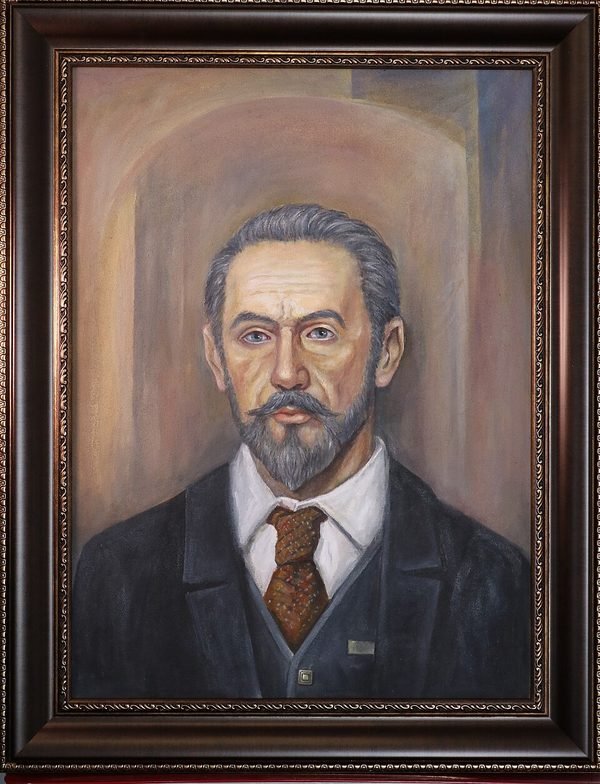
Sergei Winogradsky
1856–1953 · Russian microbiologist, ecologist and soil scientist
Sergei Winogradsky (1856-1953) was a Russian microbiologist, ecologist and soil scientist, born in Kiev, then part of the Russian Empire. He is regarded as a pioneer of the concept of biological cycles in nature and as the discoverer of chemoautotrophy, the process by which some organisms obtain energy from inorganic compounds and fix carbon from carbon dioxide, without relying on light.
After starting piano studies at the Imperial Conservatoire of Music in Saint Petersburg, he enrolled at the university in that city to study chemistry and botany, graduating in 1881. In 1885 he worked in Strasbourg with the botanist Anton de Bary, where he gained recognition for his studies of sulfur bacteria. In 1888 he settled in Zurich and began researching nitrification, the process by which certain bacteria convert ammonium into nitrite and then into nitrate. He identified the genera Nitrosomonas, Nitrosococcus and Nitrobacter.
Between 1891 and 1905 he headed the division of general microbiology at the Institute of Experimental Medicine in Saint Petersburg. There he described Clostridium pasteurianum, an obligate anaerobe, meaning an organism that cannot tolerate oxygen, able to fix nitrogen from the air. He trained Vasily Omelianski, who spread his concepts and methods in the Soviet Union. He withdrew from active research in 1905 and, in 1922, accepted the leadership of the agricultural bacteriology division of the Pasteur Institute at Brie-Comte-Robert, near Paris, where he worked on iron bacteria, nitrogen fixation by Azotobacter and the breakdown of cellulose. He died in Brie-Comte-Robert in 1953.
His legacy lives on in the Winogradsky column, a simple cylinder of sediment and water that shows microbial activity in layers and is used in microbiology teaching around the world. He is now recognised as one of the first scientists to study microbes beyond the medical context.
Contributions
- Chemoautotrophy – discovered that some organisms obtain energy from inorganic compounds and fix carbon from carbon dioxide.
- Nitrification – identified the genera Nitrosomonas, Nitrosococcus and Nitrobacter, which convert ammonium into nitrite and then nitrate.
- Clostridium pasteurianum – described an anaerobe able to fix nitrogen from the air without living in legume root nodules.
- Winogradsky column – a simple method for observing microbial ecology in sediment.
Curiosities and anecdotes
The Winogradsky column
It is a simple container with mud, water and a source of nutrients that, over time, shows layers of microorganisms. It remains a common classroom practice in microbiology.
He gave up his salary
While directing the Institute of Experimental Medicine, he renounced his salary, which was placed in a special account. These funds paid for a room for a scientific library.
Teachers and pupils
Pupils
- Vasily Omeliansky 1867–1928
Sources
Original Medicapedia text based on:

Last updated: 5 November 2026 · How Medicapedia is made
A project by Alejandro Rosàs Navarro, family physician and specialist in preventive medicine and public health. Spotted a mistake? Write to info@medicapedia.org.