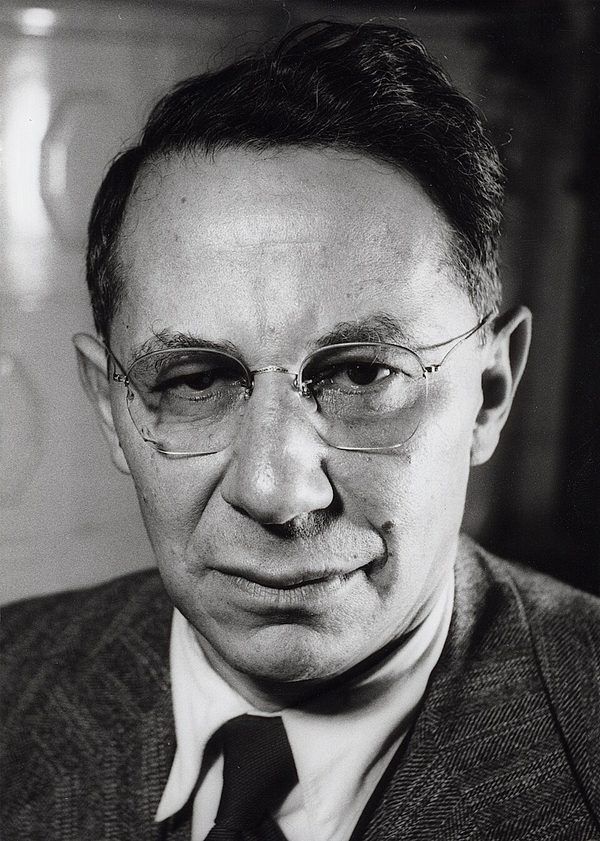
Tadeusz Reichstein
1897–1996 · Polish-born chemist and 1950 Nobel laureate in Physiology or Medicine
Tadeusz Reichstein, also known as Tadeus Reichstein, was born on 20 July 1897 in Włocławek, a town then within the Russian Empire, into a wealthy Polish-Jewish family with strong patriotic traditions. His parents were Gastawa Brockmann and Izydor Reichstein. He was given the name of Tadeusz Kościuszko, the eighteenth-century Polish national hero, a detail that shows how much Polish identity mattered in the household. His early childhood was spent in Kiev, where his father worked as an engineer. The violent pogroms that swept the Russian Empire in 1905 led the family to consider emigration, and from then on his education took place largely outside Poland. He began at a boarding school in Jena, Germany, and soon afterwards moved to Switzerland, where he completed his scientific secondary schooling in Zürich. When he began studying chemistry at the Swiss Federal Institute of Technology in Zürich, known as ETH, he already wanted a career in research. He graduated with the highest marks in 1920 and qualified as a chemical engineer.
To understand his career, it helps to recall the context. In the early twentieth century organic chemistry, the study of compounds built around carbon, was advancing quickly and beginning to make it possible to produce substances that had previously been obtained only from living things. Endocrinology, the science of glands that release hormones into the blood, was only just taking shape. Doctors knew that some glands influenced the body at a distance, but they had little idea which specific molecules did so. The concept of vitamins, small amounts of substances the body cannot manufacture for itself and must obtain from food, was also still new. Deficiency diseases such as scurvy were well recognised, yet their chemical explanation was incomplete. In this setting, collaboration between chemists and physicians became crucial, and Reichstein's training placed him right at that frontier.
Before committing fully to research, the young chemist had to work to support his family. His first job lasted six weeks and paid 200 francs. It involved analysing wine for a local merchant. He soon discovered that his employer's income came largely from certifying doubtful wines and even selling certificates to importers for wines that had never been tested. He later worked for an inventor of pocket torches whose devices still had several faults. Reichstein solved those problems, was well paid for doing so, and was able to hand his father the first 1000 francs he had earned. The episode, which mixed practical work with questions of honesty, left him with a sceptical attitude towards shortcuts in industry.
After a year in private industry, in 1921 he began a doctoral thesis under Hermann Staudinger, a pioneer of polymer chemistry, the study of very large molecules built from repeated smaller units. During this period, according to accounts, he was able to work secretly for two or three weeks in the cellar laboratory of Leopold Ruzicka, a poorly paid assistant of Staudinger who would later become one of the leading figures of Swiss chemistry. These early years gave him a thorough grounding in experimental organic chemistry, which he would later apply to very different problems.
Between 1922 and 1931 Reichstein devoted much of his time to a long project. Following a plan by Staudinger, he worked in a small private laboratory in Albisrieden, a district of Zürich, for a German company. The aim was to isolate the volatile compounds that give roasted coffee its aroma. Together with his personal assistant, Joseph von Euw, he worked on this for about nine years, often for sixteen to eighteen hours a day. The results were revealing. Coffee aroma turned out to be made of extraordinarily complex mixtures, including derivatives of furan and pyrrole, which are ring-shaped molecules containing oxygen or nitrogen, along with sulphur-containing substances. He published a series of papers on these compounds and on new methods of synthesising them, and he also studied the aromatic substances of chicory. This laboratory work, seemingly far from medicine, gave him the discipline and synthetic skill he would later need.
In 1927 he married Louise van Ufford, a Dutch woman he had known as a young guest of his mother. Their only child, Ruth, was born to the couple. His academic career progressed in Zürich, where in 1937 he became an associate professor at ETH, and then in Basel, where he became professor of pharmaceutical chemistry and later of organic chemistry, a post he held until his retirement in 1967. In Basel he also studied cardiac glycosides, plant-derived substances that alter the contraction of the heart and that fascinated pharmacologists because of their potency.
His best-known contribution to the wider public is the production of vitamin C, or ascorbic acid. The vitamin is essential to health, and its absence causes scurvy, but it was expensive to make in large quantities. Reichstein designed a synthesis that started from glucose, a simple sugar. First, glucose is converted into sorbitol by hydrogenation, a reaction in which hydrogen is added to the molecule. Fermentation then turns this compound into sorbose. Next, the hydroxyl groups, small clusters of oxygen and hydrogen that make sugars chemically reactive, are temporarily protected so that they do not react in later steps. An oxidation then produces 2-keto-L-gulonic acid, and a ring-closing reaction transforms it into vitamin C. The method greatly lowered the cost of the product and made its widespread use possible. Some modern factories still use modified versions of his process. At the same time, the British chemist Norman Haworth and his collaborators reached vitamin C by another route, and the two lines of work are recognised as independent.
The research that earned him the Nobel Prize concerned the adrenal glands, two organs sitting on top of the kidneys that produce hormones essential for regulating the body. Reichstein isolated several of these hormones and determined their structures, including corticosterone, which he described in 1936. His work culminated in the isolation of cortisone, whose therapeutic use later spread widely. In 1950 he shared the Nobel Prize in Physiology or Medicine with Edward Calvin Kendall and Philip Showalter Hench for their discoveries about the hormones of the adrenal cortex. According to the Nobel Committee, Reichstein was the first scientist born in Poland to receive this prize. The division of credit among the three laureates, combining Reichstein's chemistry with the physiological and clinical work of Kendall and Hench, has been discussed in the history of the field.
His career brought real difficulties. Reichstein had to combine poorly paid jobs with demanding research, and his Jewish and Polish background placed him in a European setting where political tensions were rising. Competition with other laboratories, especially in the race to synthesise vitamin C, produced debates over who had priority. Reichstein generally kept a reserved stance in these disputes, and his work relied on reproducible experiments rather than on public recognition.
His personal life was shaped by family and by a passion that is unusual in a chemist: botany. Reichstein designed two small gardens, one near his home on Weissenstein Strasse in Basel and another near the village of Agarone, between Bellinzona and Locarno. He also built two underground greenhouses intended for growing ferns. His garden became known for an unusually abundant harvest of black cherries. These hobbies help explain his later turn towards botany, a field that had attracted him from youth and to which he devoted decades of work.
At the age of seventy-five he announced that he would leave organic chemistry to concentrate on the cytogenetics of ferns, that is, the study of the chromosomes of these plants and how they are inherited. In the last three decades of his life he published at least 80 papers on the phytochemistry and cytology of ferns and specialised in hybridisation experiments in his greenhouses. Accounts of his later years describe him as remaining remarkably active. Past the age of ninety he was admitted to hospital to receive a pacemaker, a small device that regulates the heartbeat. It is said that on the morning of the second day after the operation he left the hospital, and that a nurse who saw him in the street ran after him and told him to return to bed at once. Reichstein responded with humour. At ninety-five he remarked that he had lived longer than expected, though he added that he still needed three more years to finish two botanical papers he was working on. He died in Basel on 1 August 1996, shortly after turning 99. At the time of his death he was the longest-lived Nobel laureate, a record he held until Rita Levi-Montalcini surpassed him in 2008.
His legacy is twofold. The industrial synthesis of vitamin C still bears his name, and some of its variants remain in use. His studies of the adrenal hormones helped lay foundations for an important part of modern pharmacology, showing that well-identified molecules can explain complex physiological effects. Reichstein combined chemistry, medicine and botany with constant curiosity, and his life is a reminder that science draws both on disciplined laboratory work and on personal enthusiasms that keep an interest in nature alive.
Contributions
- Reichstein process: a method for producing vitamin C on an industrial scale from glucose.
- Adrenal hormones: identification and description of the structure of several hormones of the adrenal cortex.
- Cortisone: isolation of this anti-inflammatory drug, for which he received the Nobel Prize in 1950.
- Cardiac glycosides: study of plant substances that act on the heart.
- Fern phytochemistry: more than 80 papers on the chemistry, chromosomes and hybridisation of these plants.
Curiosities and anecdotes
A name with history
He was named after Tadeusz Kościuszko, the Polish national hero whom his family's patriotic tradition held in high regard.
A record for longevity
At the time of his death he was the longest-lived Nobel laureate. In 2008 Rita Levi-Montalcini surpassed him.
Gardens and ferns
He designed two underground greenhouses for growing ferns and two small gardens, one of which is known for an unusually abundant crop of black cherries.
Sources
Original Medicapedia text based on:

Last updated: 5 November 2026 · How Medicapedia is made
A project by Alejandro Rosàs Navarro, family physician and specialist in preventive medicine and public health. Spotted a mistake? Write to info@medicapedia.org.