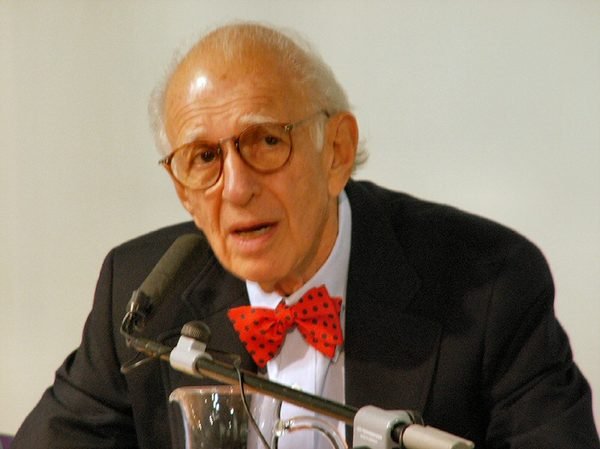
Eric Kandel
1929 · Austrian-born American neuroscientist and psychiatrist, Nobel Prize in Physiology or Medicine in 2000
Also on: their science on Newtonpedia
Eric Richard Kandel was born in Vienna on November 7, 1929, into a Jewish family that was thoroughly assimilated into the cultural life of the city. His mother, Charlotte Zimels, had been born in 1897 in Kolomyia, then part of Austria-Hungary, and his father, Hermann Kandel, in 1898 in Olesko, in Galicia. Both moved to Vienna at the beginning of the First World War, where they met and married in 1923. Shortly after Eric was born, his father opened a toy store. When Germany annexed Austria in March 1938, an event known as the Anschluss, attacks on Jews escalated and Jewish property began to be confiscated. The family sensed the danger and, unlike many others, decided to leave, though the departure came at considerable financial cost. In May 1939, Eric, then nine, and his brother Ludwig, then fourteen, boarded a ship at Antwerp and reached Brooklyn, where they joined an uncle; their parents followed later.
In New York, his grandfather tutored him in Judaic studies, and after attending the Yeshiva of Flatbush he graduated in 1944. He then went to Erasmus Hall High School, part of the New York City public system. His early interests lay in history and literature, and at Harvard he took a degree in History and Literature. His undergraduate honors thesis examined the attitudes toward National Socialism of three German writers: Carl Zuckmayer, Hans Carossa and Ernst Junger. At Harvard, psychology was dominated by B. F. Skinner, who argued that behavior should be studied without recourse to biology. Kandel, by contrast, became interested in learning and memory. A decisive turn came with the sudden death in 1951 of his favorite literature teacher, Karl Vietor, which left him feeling a deep personal loss and an unexpected gap in his schedule. By then he had met Anna Kris, the daughter of the psychoanalysts Ernst Kris and Marianne Rie, who belonged to Sigmund Freud's Vienna circle. Freud's ideas about unconscious mental processes shaped Kandel's curiosity about the biology of motivation and of conscious and unconscious memory. He changed course and began medical studies at New York University in 1952, and by graduation he was firmly committed to the biological basis of the mind.
To appreciate the significance of his work, it helps to recall the state of neuroscience in the 1950s. The brain was known to be made of neurons, cells that communicate through electrical impulses, and that communication takes place at synapses, the junctions between two neurons, where chemical messengers called neurotransmitters are released. Yet nobody knew exactly where or how memories are stored. The psychologist Karl Lashley had searched without success for a specific anatomical location for memory in the cerebral cortex. Meanwhile, in 1957, shortly before Kandel joined the Laboratory of Neurophysiology at the United States National Institutes of Health, William Beecher Scoville and Brenda Milner had described the patient known as HM, who lost the ability to form new memories after the removal of his hippocampus, a structure deep in the temporal lobe. Kandel began recording the electrical activity of hippocampal neurons with microelectrodes inserted inside individual cells. Working with Alden Spencer, he described features of these cells, but reached an uncomfortable conclusion: the general electrical properties of the hippocampus did not explain why it was so essential for memory. Its dense web of connections was also too complicated for a detailed study of individual synapses.
Kandel concluded that he needed a simpler system. Comparative studies of behavior by Konrad Lorenz, Niko Tinbergen and Karl von Frisch had shown that simple forms of learning appear even in animals with modest nervous systems. Inspired by Stephen Kuffler's work on invertebrate neurons, he chose an animal model that would allow the synaptic changes linked to learning to be analysed directly. The decision carried risk, because many senior biologists and psychologists believed that studying invertebrates could teach nothing useful about human memory. Kandel, however, expected that the principles he found would apply to humans as well. After completing his residency in psychiatry, he went to Paris in 1962 to learn from Ladislav Tauc how to work with Aplysia californica, a sea slug whose nerve cells are large and easy to identify. There he found that simple forms of learning, such as habituation, sensitization and classical conditioning, could be studied in ganglia isolated from the animal. In 1965 he published initial results, including a form of presynaptic potentiation that seemed to correspond to a simple kind of learning.
Back in New York, he worked with Irving Kupferman and Harold Pinsker to demonstrate these forms of learning in intact Aplysia. They showed that the gill-withdrawal reflex, by which the animal protects its delicate gill tissue, could be habituated, meaning weakened in response to repeated harmless stimuli, or sensitized, meaning strengthened after a painful one. Habituation is in a sense learning to ignore what is not dangerous, while sensitization means becoming more alert after an unpleasant experience. In classical conditioning, a neutral stimulus comes to provoke the same response as a harmful one after being repeatedly paired with it. Over time, Tom Carew and other colleagues extended the work from short-term memory toward the physiological processes needed for long-term memory, and the group later showed that classical conditioning could also be studied in this system. This helped narrow the apparent gap between learning in invertebrates and the more complex learning usually associated with vertebrates.
From this work emerged several principles that Kandel and his collaborators proposed. The first is that changes in synaptic strength are enough to reconfigure a neural network and its capacity to process information. The second is that a given set of connections between two neurons can be modified in opposite directions by different forms of learning: habituation weakens the synapse, while sensitization and classical conditioning strengthen it. These lasting changes in synaptic strength are the cellular mechanisms underlying short-term memory, and because they occur at several points in the circuit, memory is not stored in one specific place but distributed across the circuit. The third is that, in all three forms of learning, the duration of short-term memory depends on how long the weakening or strengthening of the synapse lasts. The fourth is that the strength of a chemical synapse can be altered in two different ways, depending on whether the circuit activated by learning is a mediating or a modulating one. Kandel also connected these findings to an old philosophical debate. John Locke held that all knowledge comes from experience, while Immanuel Kant argued that we are born with innate structures of thought. Kandel suggested that reality gives each of them partial credit: the anatomy of the circuit resembles something like Kant's built-in structures, while experience modifies the strength of particular connections within it.
The biochemical side of his research began in 1966, when James Schwartz collaborated with him on analysing the chemical changes linked to learning. It was already known that long-term memory requires the synthesis of new proteins, which short-term memory does not. By 1972 the group had evidence that a second messenger molecule, cyclic AMP, increased in Aplysia ganglia during sensitization. It was later found that the neurotransmitter serotonin activated this pathway and, in work with Paul Greengard, that protein kinase A acted as an intermediary. Later, with David Glanzman and Craig Bailey, Kandel identified the protein CREB as a factor involved in storing long-term memory. Its activation was associated with an increase in the number of synaptic connections. In other words, short-term memory was linked to functional changes in existing synapses, while long-term memory was associated with structural change. These findings also resonated with Donald Hebb's theory of learning, according to which connections that are active together become stronger. The group later used transgenic mice to study the molecular basis of memory in the vertebrate hippocampus, and the conservation of these mechanisms across very different animals was confirmed.
The difficulties of his work were, to a large extent, scientific and institutional. For years, the scientific community questioned whether such a simple animal could yield valid conclusions about human memory. Kandel answered with results showing that the molecular mechanisms recur in animals that are very different from one another. In 1974 he moved his laboratory to Columbia University, where he became the founding director of the Center for Neurobiology and Behavior, and he continued his research there for decades. Sources indicate that he was a senior investigator at the Howard Hughes Medical Institute from 1984 to 2022. In 2000 he received the Nobel Prize in Physiology or Medicine, shared with Arvid Carlsson and Paul Greengard, for discoveries about the physiological basis of memory storage in neurons. In his personal life, he met his future wife, Denise Bystryn, during his medical studies, and he settled permanently in New York City. His relationship with Vienna has been complex. When the Nobel was announced, some Austrian media presented him as an Austrian laureate, and Kandel replied that it was not an Austrian Nobel but a Jewish-American one. Afterwards, the Austrian president Thomas Klestil asked him how things could be put right, and Kandel proposed, among other things, renaming a Vienna avenue named after Karl Lueger, an antisemitic mayor of the city, which was done in 2012.
In his later years, Kandel has remained active in science and in public discussion. His textbook Principles of Neural Science, first published in 1981, is now in its sixth edition and is widely used in medical schools and university programmes. In 2008, together with Daniela Pollak, he published a study in the journal Neuron showing that mice trained to associate a specific sound with the absence of harm, a behaviour they called learned safety, displayed an effect comparable to that of some antidepressant medications. The finding was presented as a way to study the cellular interactions between drug and behavioural approaches, not as a recommendation of any treatment. In 2012 he published The Age of Insight, a historical essay on Vienna as a cradle of cultural modernism, linking doctors, artists and writers who explored the unconscious. In 2018 he published The Disordered Mind, which examines what unusual brains reveal about how the brain works. His legacy is twofold. On the one hand, he showed that memory rests on lasting changes in the strength of synapses and that these changes can be studied in the laboratory at the level of specific cells. On the other, he demonstrated that the mechanisms of learning are shared by very different animals, a finding that continues to guide research on memory and neuroscience today.
Contributions
- Aplysia californica: the sea slug that allowed memory to be studied in identifiable, accessible neurons.
- Habituation, sensitization and classical conditioning: simple forms of learning that Kandel described at the cellular level.
- Synaptic plasticity: the idea that the strength of connections between neurons can rise or fall with experience.
- Distributed memory: the proposal that memories are spread across a neural circuit rather than kept in a single place.
Curiosities and anecdotes
A sea slug for memory
Kandel chose a marine mollusk because its nerve cells are large enough to study one by one. Many colleagues of his time criticized the decision.
An award-winning book
His autobiographical and scientific account In Search of Memory received the 2006 Los Angeles Times Book Prize for Science and Technology.
Sources
Original Medicapedia text based on:

Last updated: 5 November 2026 · How Medicapedia is made
A project by Alejandro Rosàs Navarro, family physician and specialist in preventive medicine and public health. Spotted a mistake? Write to info@medicapedia.org.