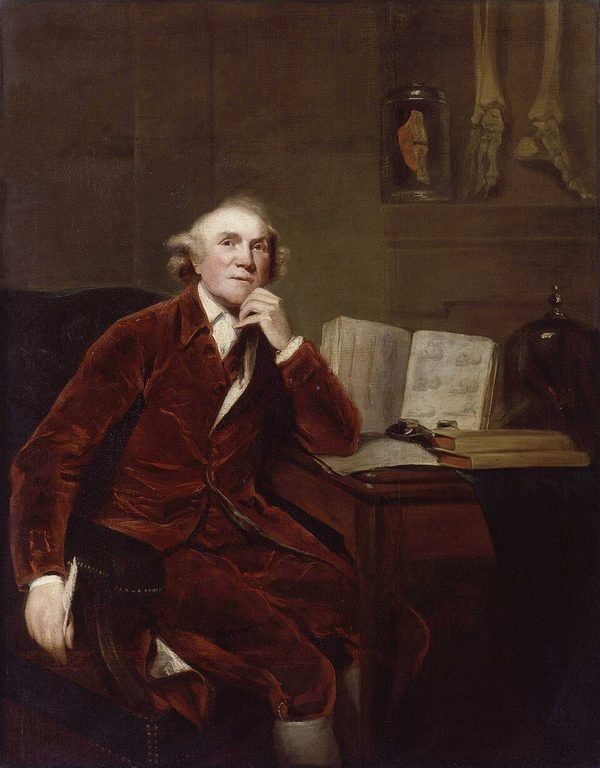
John Hunter
1728–1793 · Scottish surgeon and anatomist, pioneer of the experimental approach
John Hunter (Long Calderwood, 1728 – London, 1793) was a Scottish surgeon and anatomist who worked mainly in London in the second half of the eighteenth century. He is regarded as one of the early advocates of careful observation and experimental method in medicine, and his work covered subjects as varied as dentistry, bone growth and venereal disease.
He was the youngest of ten children. In 1748 he moved to London to work with his elder brother William, a respected anatomist, and soon began running practical dissection classes himself. He served as an army surgeon between 1760 and 1763 and in 1764 opened his own anatomy school. He became a Fellow of the Royal Society in 1767 and held posts as surgeon at St George's Hospital and to King George III. Later he became surgeon general of the army, where he pushed for appointments based on experience and merit rather than patronage.
Hunter built up a collection of nearly 14,000 anatomical preparations, many made from animals he kept alive and studied before preserving them. In 1783 he opened the collection to the public as a museum in Leicester Square. To obtain fresh bodies he dealt with resurrectionists, men who dug up recently buried corpses, a practice his students carried to other places. His theory that gonorrhoea and syphilis were one and the same disease proved wrong, although his reputation delayed the distinction between them for years. He died in 1793 after a heart attack during a meeting at St George's Hospital. He was first buried at St Martin-in-the-Fields and, in 1859, his remains were moved to Westminster Abbey.
Contributions
- Anatomical preparations: he assembled thousands of specimens from humans and animals that served as a basis for comparative anatomy.
- Bone and dental development: he studied how bones and teeth grow and remodel, laying foundations for dentistry.
- Inflammation: he read inflammation as the body's response to disease rather than the disease itself.
- Gunshot wounds: he investigated how to treat wounds caused by firearms, a common problem in the wars of his time.
Curiosities and anecdotes
The giant's skeleton
Hunter acquired the skeleton of Charles Byrne, an Irish man of great height, although Byrne had asked to be buried at sea. According to the usual account, Hunter bribed a member of the funeral party and the coffin was filled with rocks.
A fictional character
It is often said that Robert Louis Stevenson drew on Hunter's house, with its grand front and its back alley, when writing Strange Case of Dr Jekyll and Mr Hyde.
Teachers and pupils
Teachers
- William Hunter 1718–1783
Pupils
- Edward Jenner 1749–1823
Sources
Original Medicapedia text based on:

Last updated: 5 November 2026 · How Medicapedia is made
A project by Alejandro Rosàs Navarro, family physician and specialist in preventive medicine and public health. Spotted a mistake? Write to info@medicapedia.org.