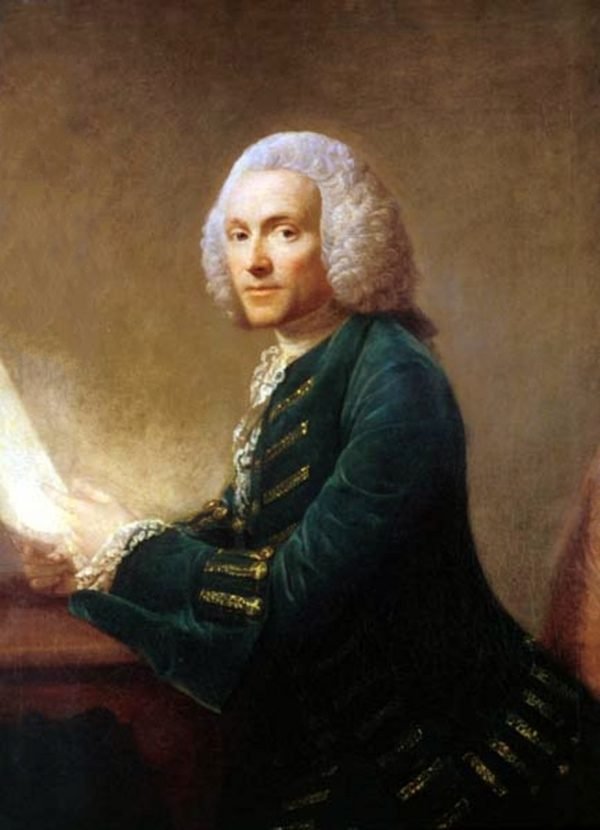
William Hunter
1718–1783 · Scottish anatomist, physician and obstetrician
William Hunter (1718-1783) was a Scottish anatomist and physician, a leading teacher of anatomy and the most prominent obstetrician of his day in London. His influence rests on his teaching as much as on his richly illustrated work on the human body.
He was born at East Kilbride, near Glasgow, and was the elder brother of the surgeon John Hunter. After studying divinity at the University of Glasgow, he turned to medicine in 1737, working under William Cullen. In London he became resident pupil to William Smellie, trained in anatomy at St George's Hospital and specialised in obstetrics. From 1746 he gave private courses in dissection and operative procedures. His courtly manners and sound judgement made him the leading obstetric consultant in the capital, although unlike Smellie he did not favour the use of forceps during delivery.
In 1768 he built an anatomy theatre and museum in Great Windmill Street, Soho, where many of Britain's leading surgeons and anatomists were trained. His best-known work, the Anatomy of the Human Gravid Uterus (1774), combined precise plates of the pregnant womb, drawn after the anatomical studies of Leonardo da Vinci. He was also an avid collector of books, coins and natural specimens, and his legacy forms the core of the Hunterian Museum and Art Gallery at the University of Glasgow. In 2010 an amateur historian suggested, without sufficient documentary evidence, that these physicians had committed murders to obtain cadavers; historians of medicine rejected the claim for lack of proof.
Contributions
- Anatomical illustration: his work on the gravid uterus combined dissection and drawing with unusual precision.
- Teaching anatomy: his Soho anatomy theatre trained many of the British surgeons of the period.
- Study of cartilage: in 1743 he published a paper on diseases of articular cartilage that is still often cited.
- Collecting legacy: his collections form today the core of the University of Glasgow museum.
Teachers and pupils
Pupils
- Charles Bell 1774–1842
- John Hunter 1728–1793
- Charles White 1728–1813
Sources
Original Medicapedia text based on:

Last updated: 5 November 2026 · How Medicapedia is made
A project by Alejandro Rosàs Navarro, family physician and specialist in preventive medicine and public health. Spotted a mistake? Write to info@medicapedia.org.