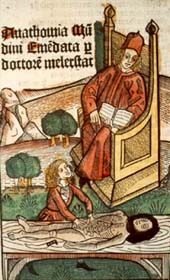
Mondino de Liuzzi
1275–1326 · Italian physician, anatomist and professor of surgery
Mondino de Luzzi (c. 1270–1326) was an Italian physician, anatomist and professor of surgery who worked in Bologna. He is often called the “restorer of anatomy” because he revived the public dissection of human bodies as a teaching tool and wrote one of the first modern anatomical texts.
He came from a Florentine family settled in Bologna with ties to pharmacy and medicine; his uncle Luzio taught medicine. He studied at the city’s university, graduated around 1290, and from 1306 to 1324 held a public post teaching practical medicine and surgery. He was a pupil of Taddeo Alderotti and a fellow student of Henri de Mondeville. He also took part in city government and served Bologna as a diplomat.
His best-known achievement is the public dissection of January 1315, carried out before medical students and other spectators. Unlike the common practice of the time, in which a professor read from a book while a surgeon did the cutting, Mondino often examined the body himself and built that experience into his teaching. His Anathomia (1316), a guide to dissection, was copied and printed for centuries. Even so, he relied heavily on Galen and on Arabic commentators, and he repeated errors such as the supposed “miraculous network” of vessels at the base of the human brain, which in fact occurs only in hoofed animals.
Contributions
- Public dissection revived a practice that had nearly disappeared and made it part of university teaching.
- Anathomia (1316) offered an ordered handbook that guided students through each stage of dissection.
- Hands-on teaching combined reading texts with direct observation of the body.
- Galenic framework kept the authority of Galen, along with errors that later anatomists would correct.
Curiosities and anecdotes
Ants as stitches
Mondino describes closing an incised intestinal wound by letting large ants bite its edges and then cutting off their heads. One scholar reads this as an early anticipation of surgical staples.
A tomb with a relief
His granite tomb is decorated with a bas-relief by Boso of Parma showing a teacher seated in a large chair lecturing to students.
Teachers and pupils
Teachers
- Taddeo Alderotti 1215–1295
- Henri de Mondeville 1260–1320
Pupils
- Alessandra Giliani 1307–1326
Sources
Original Medicapedia text based on:

Last updated: 5 November 2026 · How Medicapedia is made
A project by Alejandro Rosàs Navarro, family physician and specialist in preventive medicine and public health. Spotted a mistake? Write to info@medicapedia.org.