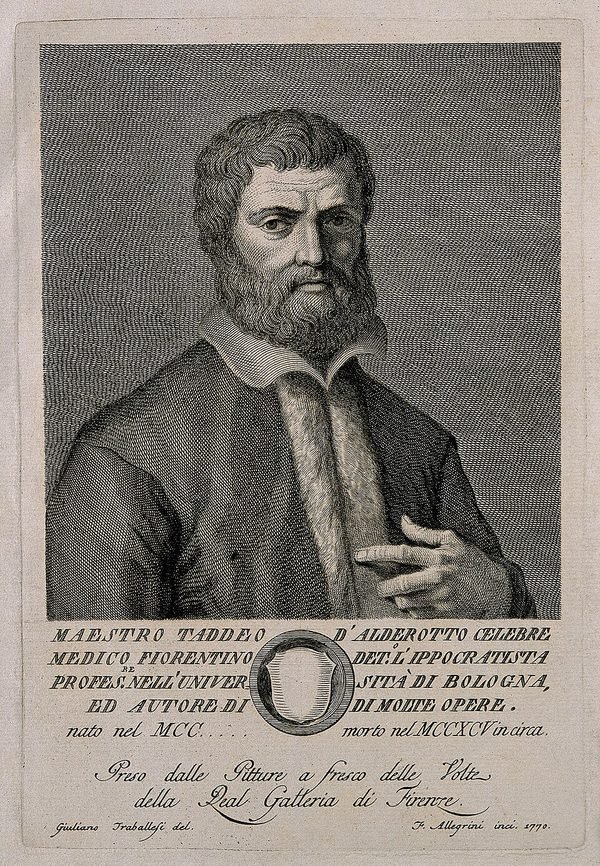
Taddeo Alderotti
1215–1295 · Italian physician and professor of medicine at the University of Bologna
Taddeo Alderotti (Florence, between about 1206 and 1215 – Florence, 1295) was an Italian physician who taught medicine at the University of Bologna and played a central role in reviving learned medicine in Europe during the High Middle Ages. He is an important figure in the shift from craft-based medical practice to organized university teaching.
He received his early education in Florence and moved to Bologna in the mid-thirteenth century, a city renowned for the study and practice of medicine. There he became a popular lecturer who drew large numbers of students. His courses were built on the works of Hippocrates, Galen and Avicenna, texts that had reached Western Europe through earlier translations and formed the foundation of medical learning. Alderotti applied the Aristotelian scheme of four causes, examining each subject through its matter, form, author and purpose.
His writings include the Consilia, a collection of clinical cases with detailed analyses, and commentaries on Hippocratic and Galenic texts. He is also credited with a method of repeated distillation for concentrating ethanol, which reached a purity of 90 per cent. His pupils included Mondino de' Liuzzi, whose anatomical work was highly influential. Dante mentions him in the Paradiso, with a critical tone toward his pursuit of worldly fame. In old age he gave up teaching and moved his practice to Venice. His will shows that he died a wealthy man, the result of his practice and investments.
Contributions
- Organised medical teaching: he was one of the first to give structured medical lectures within a university.
- The four causes method: he applied Aristotle's classification of causes to medicine to structure his explanations.
- Consilia: a collection of clinical case records that served as a model for medical documentation.
- Ethanol distillation: he described a method of repeated fractional distillation to obtain highly pure alcohol.
- Training of pupils: among his students was Mondino de' Liuzzi, a leading figure in medieval anatomy.
Curiosities and anecdotes
Distilling alcohol
One of his works describes repeated fractional distillation through a water-cooled still, which could reach an ethanol purity of 90 per cent.
Dante and Alderotti
Dante mentions him in the Paradiso, where he seems to criticise him for seeking learning out of worldly ambition rather than spiritual motives.
Teachers and pupils
Pupils
- Mondino de Liuzzi 1275–1326
Sources
Original Medicapedia text based on:

Last updated: 5 November 2026 · How Medicapedia is made
A project by Alejandro Rosàs Navarro, family physician and specialist in preventive medicine and public health. Spotted a mistake? Write to info@medicapedia.org.